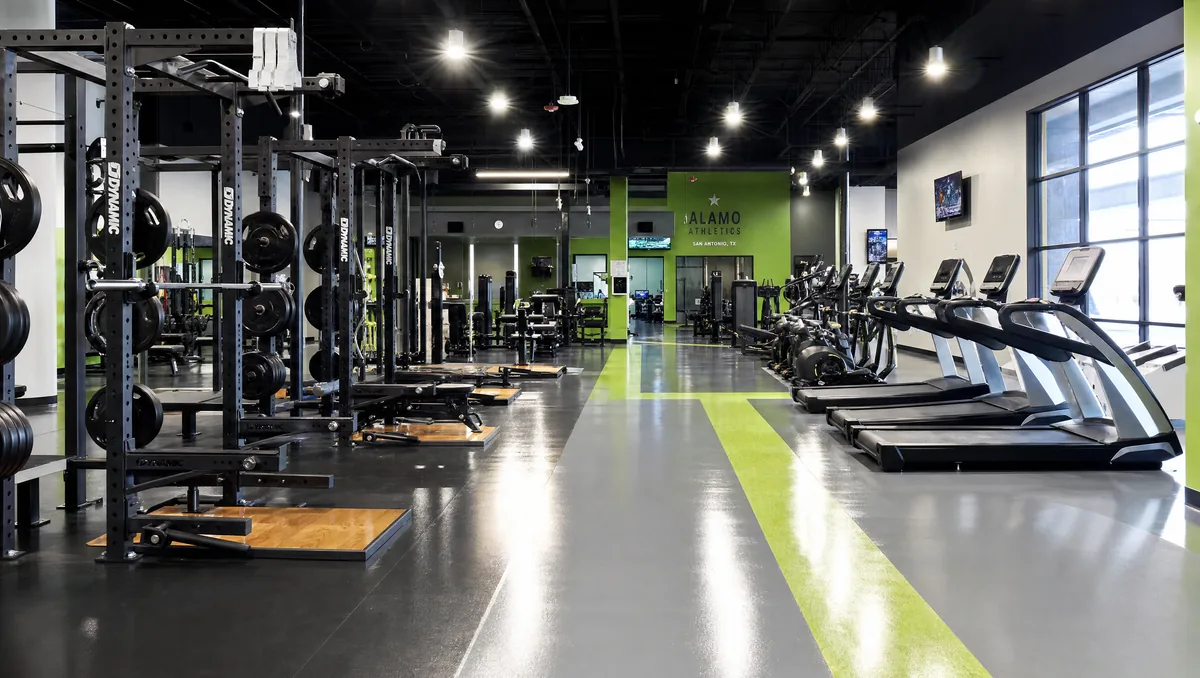
If you own or manage a gym in San Antonio, you already know your floor takes more abuse in a month than most commercial floors take in five years. Dropped barbells, sweat, spilled pre-workout, mop buckets, HVAC condensation off metal roofs in August, and hundreds of feet moving across the same six-foot lane every single day. Most facility owners default to rubber tile or vinyl because that's what the last three gyms they walked into had. Default isn't the same as best.
We install and repair floors for CrossFit boxes, 24-hour chains, medical fitness centers, and boutique studios all over San Antonio - from Stone Oak to Southtown to the industrial corridors near Loop 410. Increasingly, when owners run the numbers on lifespan, hygiene, and downtime, they're specifying epoxy and polyaspartic systems over rubber and vinyl, even in zones that traditionally "always got rubber." This guide breaks down why, and where each material actually makes sense.
What Makes Gym Flooring Different from Residential Flooring
A commercial fitness floor deals with conditions unlike almost any other commercial environment. Understanding what you're actually asking a floor to handle makes the material decision obvious:
- Point-load impact - dropped barbells and kettlebells concentrate hundreds of pounds into a few square inches, repeatedly, in the same spots
- Constant moisture exposure - sweat, spray bottles, mop water, and San Antonio's humidity above 60% most of the summer
- Chemical exposure - sanitizers, disinfectant sprays, and gym-grade cleaners harsher than typical janitorial products
- 24/7 or near-24/7 use - almost no downtime window for repairs or refreshes
- Multi-zone functionality - lifting, cardio, turf sleds, and group class studio often in one facility
Rubber Tiles: The Default Choice and Its Drawbacks
Rubber tile is the industry default for a reason - it's available everywhere, installers know it, and it handles impact reasonably well in moderate-use zones. Installed cost typically runs $4–$8/sq ft. But rubber has real limitations that compound over time in a busy commercial gym.
Seams everywhere. Rubber tiles are individual pieces, which means joints running across the entire floor. Those joints collect moisture, bacteria, chalk dust, and debris. No matter how often you mop, you can't fully clean a seamed rubber floor - and in San Antonio's humidity, that becomes a hygiene problem fast.
Odor retention. Rubber is porous. It absorbs sweat and cleaning chemicals over time and eventually holds that odor even after cleaning. Walk into a 5-year-old rubber-floored gym and you'll know exactly what this means.
Curling and shifting. San Antonio's humidity swings cause rubber tiles to expand and contract. Edges lift, tiles shift, and the resulting trip hazards in a weight room are a liability issue, not just an aesthetic one.
Limited lifespan in heavy-use zones. 5–8 years in a moderately busy gym; significantly shorter in free weight zones under real barbell traffic. Replacement means facility downtime and floor disposal costs.
Vinyl Plank and Roll: Fast but Limited
Vinyl flooring - both plank and roll - gets installed in gyms because it's fast, affordable ($3–$6/sq ft installed), and looks clean on opening day. The problems show up under real gym conditions:
- No real impact tolerance - dropped weights crack, dent, and gouge vinyl. A single misdropped barbell can require a section replacement
- Seam and edge failure under moisture - vinyl lifts at seams in humid environments, especially when mopped daily
- Slip risk when wet - many vinyl surfaces become hazardous with sweat or water, a significant safety concern in cardio zones
- Short realistic lifespan - 3–5 years under genuine commercial gym traffic before replacement becomes unavoidable
Why Epoxy Works for Commercial Fitness Facilities
A properly zoned epoxy system addresses the actual failure modes of rubber and vinyl. Installed cost typically runs $5–$12/sq ft depending on system and zoning - comparable to or only marginally above rubber when you account for the full lifecycle.
Impact Resistance
100% solids epoxy with broadcast quartz or flake, or a urethane cement base in heavy-impact zones, distributes point-load force rather than denting or tearing. Built up at 60–125 mils (and thicker for Olympic lifting platforms), it's designed for the exact impact loads that destroy rubber and vinyl. See more on our gym and fitness center flooring service page.
Hygiene
Fully seamless, non-porous, no grout lines, and no tile joints - the surface you clean is the surface you actually get clean. Antimicrobial topcoat additives are available for facilities with elevated sanitation requirements (medical fitness centers, physical therapy clinics integrated with gyms).
Zoning Flexibility
Epoxy systems can be zoned by color, texture, and formulation within a single facility. Heavy-impact lifting zones get a thicker, tougher system; cardio zones get a textured anti-slip topcoat; wet areas get cove base integration. One contractor, one installation, one coherent floor - without the seam problems of combining multiple flooring materials.
Durability and Lifecycle Cost
Realistically lasts 10–15+ years before a topcoat refresh versus 5–8 for rubber and 3–5 for vinyl. When you annualize those costs - including replacement downtime, disposal, and reinstallation - epoxy frequently comes out cheaper than rubber over a 10-year period, even with higher upfront cost. See our commercial epoxy flooring and epoxy floor coating pages for more on system options.
Best Epoxy Systems for Gyms
| System | Best For | Key Property |
|---|---|---|
| 100% solids epoxy with quartz/flake broadcast | General areas, locker rooms, hallways, reception | Seamless, cleanable, slip-resistant texture |
| Polyaspartic topcoats | Full-facility use when fast return is needed | Back in service 24–48 hours per zone |
| Urethane cement | Olympic platforms, strongman areas, turf-sled lanes | Highest impact resistance, tolerates heaviest loads |
| Anti-slip textured topcoat | Cardio zones, showers, ADA-required areas | Wet-surface slip resistance |
Zoning a Gym Floor: Lifting Areas, Cardio, Courts
The biggest mistake gym owners make with epoxy is treating the whole floor as one zone. A well-designed gym floor plan uses different systems for different demands - and controls budget by applying premium systems only where they're actually needed.
Free Weight and Lifting Platforms
Thickest build in the facility. Urethane cement or heavy-mil epoxy with aggregate broadcast. This is where barbells land, racks sit, and chalk flies. The floor needs to absorb impact without cracking and clean up without staining.
Cardio and Machine Rows
Prioritize slip resistance and easy cleaning over maximum impact tolerance. Standard broadcast epoxy with a textured anti-slip topcoat handles treadmill and bike traffic well. Machine rubber feet won't damage cured epoxy.
Group Class and Turf Areas
Often a combination approach: epoxy perimeters and transition zones with rubber or turf inlays only where cushioning is functionally required for jumping, floor work, or sled pushing. Epoxy handles the permanent structure; specialty surfaces go only where they add genuine value.
Locker Rooms and Wet Areas
Slip-resistant sealed epoxy with integral cove base (eliminating the floor-wall joint where water infiltrates and mold grows). This zone particularly benefits from epoxy's seamless, non-porous surface over rubber or tile.
The Bottom Line
For a San Antonio gym running real volume in real humidity with real impact loads, a properly zoned epoxy system holds up longer, cleans easier, and costs less per year of service life than the default flooring most facilities still install. The upfront premium over rubber is real; the 10-year math usually isn't.
Rubber and vinyl still make sense in specific applications - low-budget buildouts, temporary spaces, or zones where cushioning is the primary requirement. But as the default choice for a commercial fitness facility expected to run hard for a decade, they consistently underperform.
Free Facility Walkthrough for San Antonio Gyms
We assess your zones, traffic loads, and slab condition before recommending a system. No pressure to spec urethane cement everywhere when standard epoxy will do the job - honest zoning advice, accurate quote.
Request Your Free Quote →FAQ
Is epoxy too hard and unforgiving for a gym floor compared to rubber?
For general traffic, no. The concern is legitimate for high-impact zones like Olympic lifting platforms - there we spec urethane cement (which has more flex than standard epoxy) or a hybrid rubber/turf inlay only in that specific zone. The rest of the facility benefits from epoxy's durability without any hardness concern.
How long does installation take, and can we stay open?
Polyaspartic topcoats can be back in service within 24–48 hours per section, making phased zone-by-zone installation possible in a live facility. Full 100% solids systems need 3–5 days cure before full load use. Most gym installations complete in 2–5 days total, often scheduled around operating hours.
Does epoxy hold up to San Antonio humidity and slab moisture?
Yes - we test moisture vapor transmission on every commercial slab and use moisture-mitigating primers where needed. This is actually an advantage over vinyl, which is significantly more prone to adhesive failure under humidity. San Antonio's climate is one of the reasons we see vinyl fail in gyms faster than the product spec would suggest.
What does a gym epoxy floor cost per square foot?
$5–$12/sq ft depending on system, zoning, and slab condition. Heavy-impact urethane cement areas run at the top of that range; standard broadcast epoxy for cardio or lobby areas is at the lower end. We quote zone-by-zone after a facility walkthrough - you only pay premium pricing for zones that actually need it.