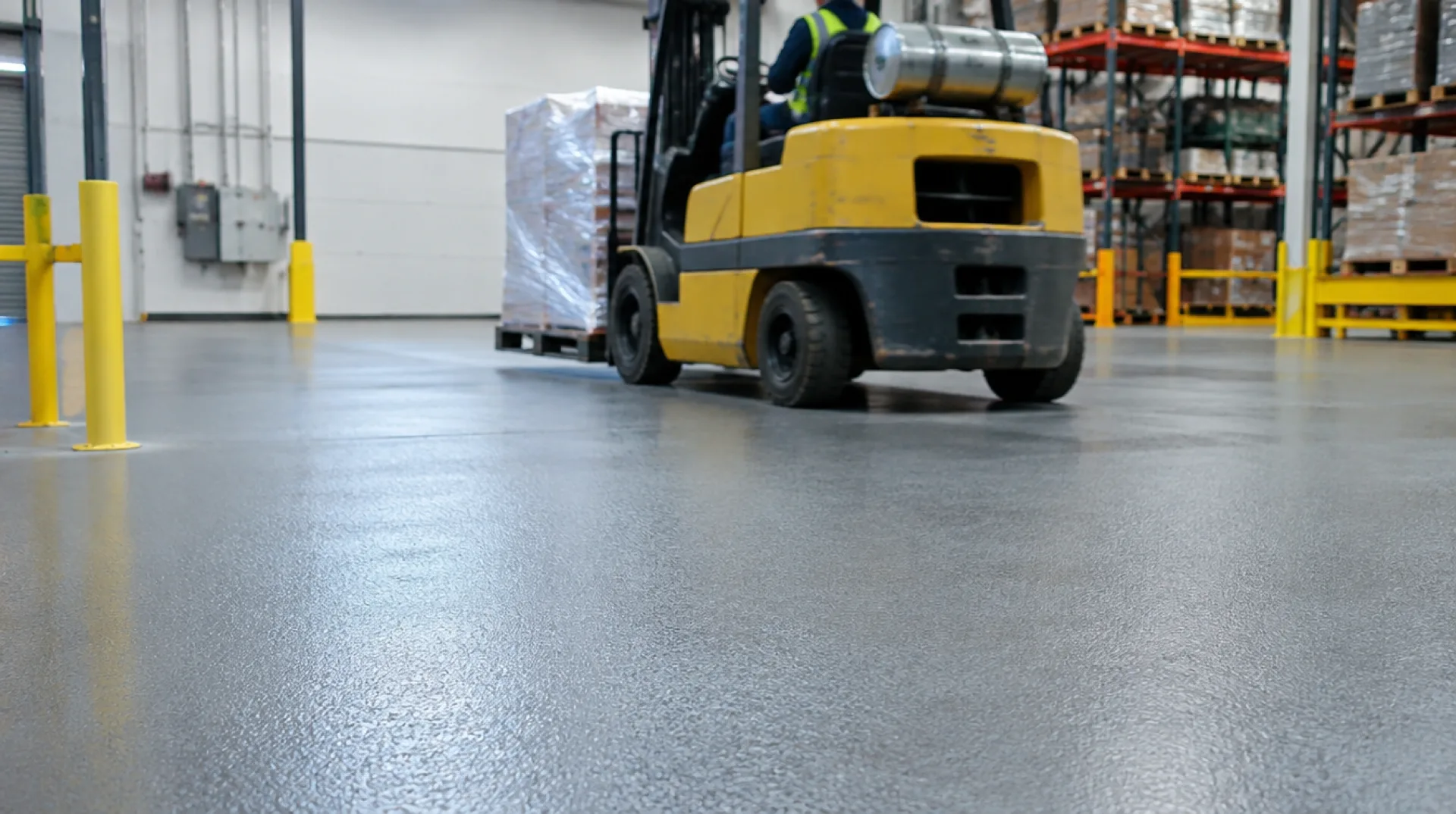
For San Antonio facilities with heavy, continuous forklift traffic, a urethane cement floor generally outperforms standard epoxy thanks to its greater film thickness and superior impact resistance - making it the stronger choice for main aisles, loading docks, and any zone that takes frequent point-impact stress from equipment, dropped pallets, or heavy loads.
Why Forklift Traffic Demands More Than Standard Epoxy
Standard epoxy performs well under moderate rolling loads, but continuous heavy forklift traffic - especially from steel-wheeled equipment or high-frequency multi-shift operations - concentrates wear and impact stress in ways that can exceed epoxy's typical film thickness and impact tolerance. Urethane cement is engineered specifically for these more demanding conditions, with a considerably thicker application (often 1/4 inch or more, compared to epoxy's typical 10-20 mil coating) that absorbs impact and resists abrasion far better under sustained heavy equipment use.
Impact and Abrasion Resistance Compared
The core performance difference comes down to how each system handles point-impact stress - a dropped pallet, a forklift fork striking the floor, or a heavy load set down hard. Epoxy's thinner film is more prone to chipping or cracking under this kind of sharp impact than urethane cement's thicker, more resilient matrix, which is specifically formulated to flex and absorb impact rather than crack. For facilities weighing the two systems more broadly, our comparison of urethane cement vs. epoxy cost covers how this durability difference factors into overall project economics beyond just the upfront price difference.
Thermal Shock Tolerance for Freezer and Dock Applications
Facilities with cold storage, freezer zones, or loading docks that cycle between outdoor temperatures and a climate-controlled interior face an additional stress factor: thermal shock from repeated temperature cycling. Urethane cement is specifically engineered to tolerate this kind of thermal cycling far better than standard epoxy, which is more prone to cracking or delamination when repeatedly stressed between cold and warm temperatures. This makes urethane cement a particularly strong fit for any facility combining heavy forklift traffic with a freezer or dock zone, since both demanding conditions point toward the same system recommendation.
Comparing Systems for Forklift-Heavy Facilities
| Factor | Standard Epoxy | Urethane Cement |
|---|---|---|
| Film thickness | 10-20 mils | 1/4 inch+ |
| Impact resistance | Moderate | Excellent |
| Thermal shock tolerance | Limited | Excellent |
| Best use case | Moderate traffic | Heavy forklift, freezer/dock |
Zone-specific specification is usually the right approach: rather than choosing one system for an entire facility, main forklift aisles and dock zones often warrant urethane cement while lower-traffic storage areas can use standard epoxy at a lower overall project cost.
Installation Thickness and Project Downtime
Urethane cement's greater thickness means a more involved installation process than standard epoxy, typically requiring more cure time per zone and a more specialized installer skill set to properly place and finish the thicker material. This generally translates to a longer installation timeline for urethane cement compared to a standard epoxy application, which is a real tradeoff facilities need to plan around, particularly if minimizing downtime is a priority alongside long-term durability. Phasing the installation zone by zone, similar to how a recoat project gets scheduled around active operations, keeps the rest of a facility running while the highest-priority zones get the more time-intensive urethane cement treatment first.
Cost vs. Lifespan Over Time
Urethane cement costs more upfront than standard epoxy, driven by both its greater material volume and the more specialized labor required for proper installation. However, in a genuinely heavy-forklift-traffic zone, urethane cement's longer service life before needing recoating or repair often results in a lower total cost over the floor's lifetime compared to an epoxy floor that needs more frequent attention under the same demanding traffic conditions. This cost equation flips for lower-traffic zones, where epoxy's lower upfront cost and adequate performance under lighter use make it the more cost-effective choice without needing urethane cement's added durability that wouldn't get fully utilized anyway.
Get the Right System for Your Traffic Level
We assess forklift traffic patterns zone by zone and recommend urethane cement or epoxy based on your facility's actual demands.
Request a Free QuoteReal-World Scenario: A Distribution Center Retrofit
A San Antonio distribution center running continuous multi-shift forklift operations found its original epoxy floor developing visible chipping and rutting in main aisles within just three years of installation, well short of epoxy's typical expected lifespan under more moderate traffic. An assessment attributed the premature wear to the facility's unusually heavy, continuous forklift volume exceeding what the original epoxy specification was designed to handle. The fix involved retrofitting just the main traffic aisles and dock zones with urethane cement while leaving the lighter-traffic storage areas on their original epoxy, a targeted upgrade that addressed the actual problem zones without the cost of a full-facility urethane cement replacement.
Matching System Choice to Equipment Type
Beyond traffic volume, the specific type of equipment matters too - steel-wheeled forklifts common in some heavy industrial settings are considerably harder on flooring than rubber-wheeled equipment used in lighter-duty warehouse operations. Facilities using steel-wheeled or solid-tire equipment, or running equipment at higher speeds to meet throughput targets, should weight their system decision more heavily toward urethane cement even in zones that might otherwise seem moderate-traffic, since equipment type meaningfully shifts the wear profile beyond what traffic volume alone suggests. Reviewing our full urethane cement flooring service page covers additional specification factors worth discussing with a contractor before finalizing a system choice for a specific facility's equipment mix.
Estimating Traffic Volume Before Choosing a System
Before defaulting to urethane cement across an entire facility, it's worth actually quantifying traffic volume rather than assuming every aisle qualifies as "heavy" traffic. A rough count of forklift and pallet-jack passes per aisle over a representative shift gives a much more accurate basis for system selection than a general impression of which areas feel busiest. Our detailed guide on forklift traffic and warehouse floor coating longevity walks through how to translate this kind of traffic data into a concrete system recommendation for each zone, rather than guessing based on visual impression alone, which often overestimates or underestimates actual wear-driving traffic volume in specific aisles.
Combining Urethane Cement With Slip-Resistant Texture
Heavy forklift traffic zones often benefit from combining urethane cement's impact resistance with an aggregate broadcast finish for added slip resistance, particularly in areas near dock doors or wash-down zones where moisture and impact stress overlap. This combination addresses two distinct demands simultaneously - impact durability from equipment traffic and slip safety for personnel working in the same zone - rather than treating them as separate specifications that might otherwise be addressed with two different, less complementary systems.
Planning a Phased Upgrade From Epoxy to Urethane Cement
Facilities with an existing epoxy floor showing premature wear in specific heavy-traffic zones don't necessarily need to replace the entire floor to address the problem. A targeted upgrade - removing and replacing just the worst-affected aisles or dock zones with urethane cement while leaving adequately performing epoxy in place elsewhere - is often the most cost-effective path forward, addressing the actual pain points without the expense of a full-facility system change. This kind of phased approach also allows a facility to spread the cost and disruption of the upgrade across a longer timeline rather than committing to one large capital project all at once, which can make budgeting easier for facilities without a dedicated capital improvement fund set aside for flooring specifically.
Working With a Contractor Experienced in Both Systems
Not every flooring contractor has equal depth of experience with both standard epoxy and urethane cement, since urethane cement's thicker application and more specialized installation technique genuinely requires more specific expertise than a standard epoxy job. When evaluating contractors for a heavy-traffic warehouse project, asking specifically about their urethane cement installation experience - separate from general epoxy experience - and requesting examples of similar heavy-forklift-traffic projects they've completed helps confirm they're genuinely equipped for this more demanding system rather than defaulting to epoxy simply because it's what they're more comfortable installing.
Long-Term Facility Planning Around Traffic Growth
Facilities anticipating growth in forklift traffic - from expanding operations, adding a second shift, or increasing automation that brings more frequent equipment movement - should factor that future traffic increase into today's flooring decision rather than specifying purely for current conditions. Choosing urethane cement proactively for zones expected to see meaningfully more traffic within the next few years often costs less than installing standard epoxy now and upgrading again once traffic outgrows it, since a single well-specified installation avoids the added cost and disruption of a second flooring project down the line.