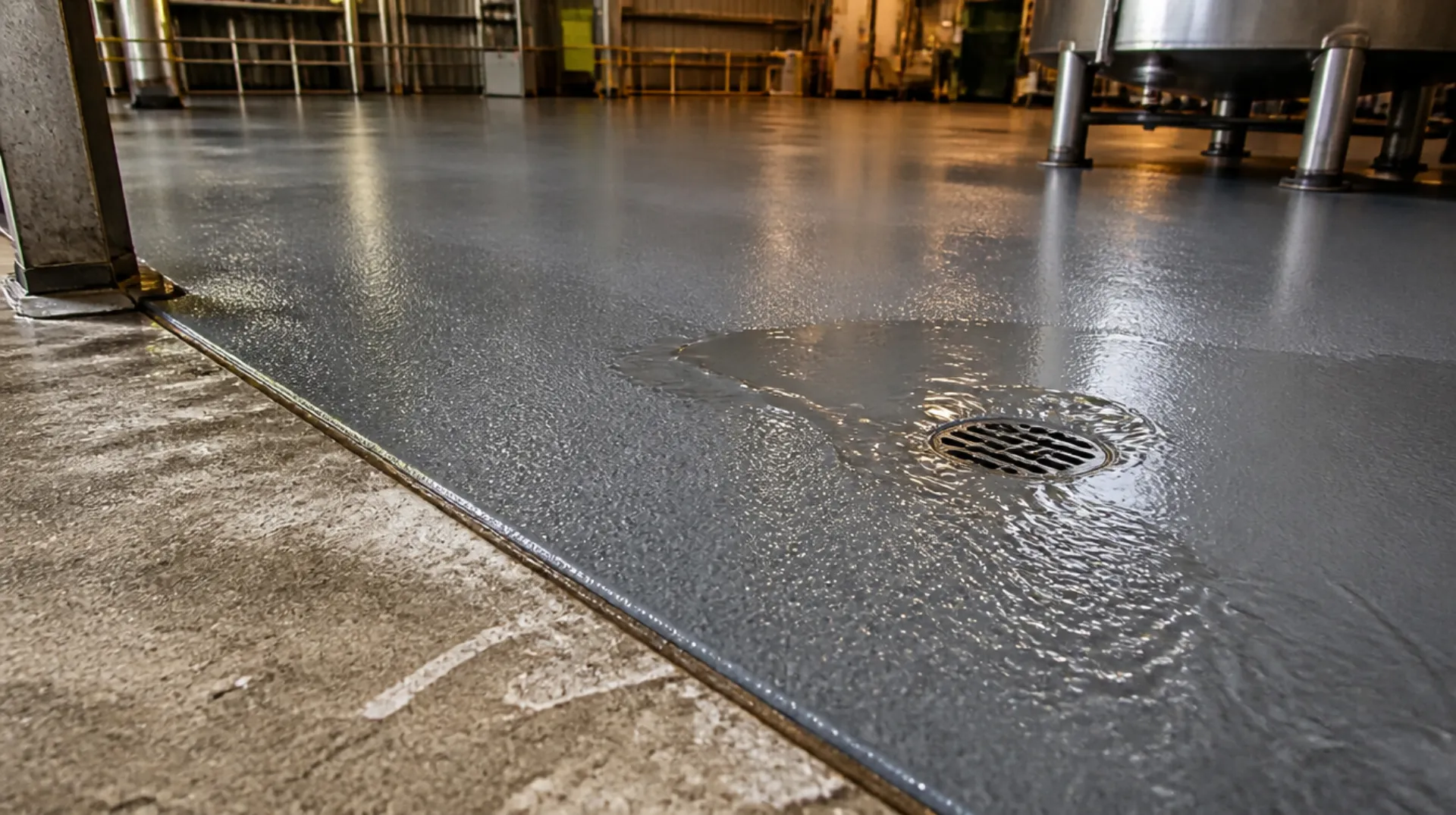
Urethane cement resists the hard-water mineral staining and etching that damages bare concrete and many standard epoxy coatings, because it's dense and chemically resistant by nature rather than relying on a topical sealer that wears through over time. For San Antonio facilities dealing with constant washdown - food processing, industrial kitchens, wash bays - that built-in resistance is the difference between a floor that holds up for decades and one that needs constant patching and resealing.
Why San Antonio's Hard Water Causes Mineral Buildup and Etching
San Antonio draws much of its municipal water from the Edwards Aquifer, a limestone formation that gives the local water supply a notably high mineral content - primarily calcium and magnesium carbonates. When that hard water repeatedly contacts unprotected concrete, evaporation leaves behind mineral deposits that build up on the surface over time, and in facilities using acidic cleaning agents to fight that buildup, the acid can etch into the concrete itself, roughening and weakening the surface with each cleaning cycle. Standard epoxy coatings can slow this process compared to bare concrete, but many formulations still show etching and dulling under sustained hard-water and cleaning-chemical exposure, particularly at floor drains and low points where water pools before draining.
What Makes Urethane Cement Chemically Resistant
Urethane cement is a cement-based system modified with urethane resins, resulting in a denser, less porous matrix than standard concrete or even many epoxy coatings. That density is what gives it its resistance: there are simply fewer microscopic pathways for water, minerals, and cleaning chemicals to penetrate and cause damage from within. Urethane cement also tolerates a wider range of pH exposure - both acidic and alkaline cleaning agents commonly used in washdown and descaling - without the surface breakdown that can affect standard epoxy over repeated exposure. Its thermal stability is a related advantage: urethane cement handles the temperature swings of hot-water washdown followed by cooler ambient conditions without the stress cracking that can develop in more rigid coating systems.
Comparison: Chemical and Water Resistance
| Surface | Chemical Resistance | Water Exposure Tolerance | Temp Range |
|---|---|---|---|
| Bare Concrete | Poor | Poor (absorbs, stains) | Moderate |
| Standard Epoxy | Moderate | Good | Moderate |
| Urethane Cement | Excellent | Excellent | Excellent, wide range |
Why this matters at floor drains specifically: drains and low points see the most concentrated, repeated water exposure in any washdown facility, which is exactly where mineral buildup and etching show up first on an unprotected or under-specified floor.
Best-Fit Facility Types for San Antonio
Facilities with constant water exposure and washdown requirements get the most value from urethane cement's resistance profile. Food and beverage processing plants, industrial kitchens in restaurants and institutional settings, vehicle and equipment wash bays, and cold storage anterooms where condensation and washdown overlap are all strong candidates. San Antonio's substantial food-processing and hospitality sector in particular deals with daily, sometimes multiple-times-daily washdown cycles using hot water and sanitizing chemicals, conditions that steadily degrade a less resistant floor system over just a few years. Our urethane cement floor service page covers the systems we install across these facility types throughout San Antonio.
Installation and Maintenance in Hard-Water Environments
Installing urethane cement in a facility that will see heavy washdown starts with the same rigorous surface prep as any high-performance floor system - grinding or shot-blasting to remove contamination and create a bondable profile - but the mix design and cure schedule are specifically selected for chemical and water resistance rather than just general durability. Once installed, maintenance is notably simpler than for a hard-water-exposed epoxy or bare concrete floor: routine washdown with standard cleaning agents is typically sufficient, without the periodic resealing or acid-neutralizing treatments that concrete or lower-grade coatings may need to manage ongoing mineral exposure.
Dealing With Hard-Water Damage on an Existing Floor?
We'll assess your current floor's condition and recommend a urethane cement system built for your washdown volume.
Request a Free QuoteComparing Urethane Cement to Other Chemical-Resistant Options
Facilities weighing urethane cement against other high-performance flooring should understand where the tradeoffs land. Our guide on urethane cement vs. epoxy cost comparison for San Antonio facilities breaks down the upfront cost difference in more detail, which is worth reviewing alongside the long-term resistance profile covered here. For facilities specifically in food processing, our post on urethane cement flooring for San Antonio food processing facilities covers related chemical and thermal exposure considerations that often overlap with hard-water resistance needs.
Drainage Design and Slope Considerations
Even the most chemically resistant flooring benefits from proper drainage design, since standing water - regardless of how resistant the floor is to it - creates slip hazards and can accelerate wear at low points over time. Facilities installing or replacing urethane cement flooring often use the project as an opportunity to correct inadequate slope toward drains, ensuring water actually moves off the floor promptly rather than pooling even briefly. This is particularly relevant in San Antonio's hard-water context, since standing water evaporates and leaves mineral residue behind even on a resistant surface - proper slope minimizes how long water sits before draining, reducing the mineral deposit buildup that would otherwise require more frequent cleaning to manage.
Signs an Existing Floor Has Hard-Water Damage
Facilities unsure whether hard water is actively damaging their current floor can look for a few telltale signs. A chalky, white mineral film that returns quickly after cleaning, visible etching or roughening concentrated near drains and low points, and a floor that seems to require increasingly aggressive or frequent cleaning to maintain its appearance are all indicators that the current surface isn't holding up to the facility's water exposure. Catching these signs early and transitioning to a resistant system like urethane cement before the underlying concrete sustains structural damage typically costs significantly less than waiting until full floor replacement becomes necessary.
Understanding San Antonio's Water Hardness in Context
San Antonio's water hardness typically measures in the range of 15-20 grains per gallon depending on the specific source and season, which places it firmly in the "very hard" category on standard water hardness scales. For comparison, water is generally considered hard above 7 grains per gallon, meaning San Antonio facilities are dealing with mineral concentrations well beyond what triggers noticeable scale and staining issues in many other markets. This matters directly for flooring decisions, since a coating system that performs adequately in a moderate-hardness market may show mineral-related wear substantially faster once installed in San Antonio's harder water conditions - a gap that often surprises facility owners relocating from other regions and specifying flooring based on their previous location's experience rather than local conditions.
How Cleaning Chemical Choice Interacts With Hard Water
The specific cleaning chemicals a facility uses compound or mitigate hard-water effects depending on their formulation. Acidic descaling agents, commonly used specifically to combat mineral buildup, can accelerate etching on less-resistant surfaces even as they remove visible scale, creating a cycle where more aggressive cleaning is needed more often as the underlying surface degrades. Facilities using urethane cement generally have more flexibility in cleaning chemical choice, since the surface's inherent chemical resistance means routine neutral-pH cleaning is typically sufficient without needing aggressive acid-based descaling in the first place - reducing both the chemical exposure and the labor involved in maintaining floor appearance over time. Facility managers switching to urethane cement from a more vulnerable surface sometimes find they can simplify their entire washdown chemical program as a secondary benefit beyond the floor's improved durability.
Warranty and Long-Term Value in Washdown Facilities
Because urethane cement carries a higher upfront material and installation cost than standard epoxy, facility owners should evaluate warranty terms and long-term value calculations rather than comparing sticker prices alone. A urethane cement floor's substantially longer service life in a heavy washdown environment - often 15-20+ years versus 5-10 years for a comparable epoxy system exposed to the same hard water and chemical conditions - typically means a lower total cost of ownership even with the higher initial investment. Facilities budgeting for a new or replacement floor in a washdown-heavy space should request lifecycle cost estimates from contractors rather than evaluating quotes purely on installed price per square foot, since the system that costs more upfront often costs meaningfully less across a 15-20 year ownership horizon once repair frequency and eventual full replacement timing are factored in.