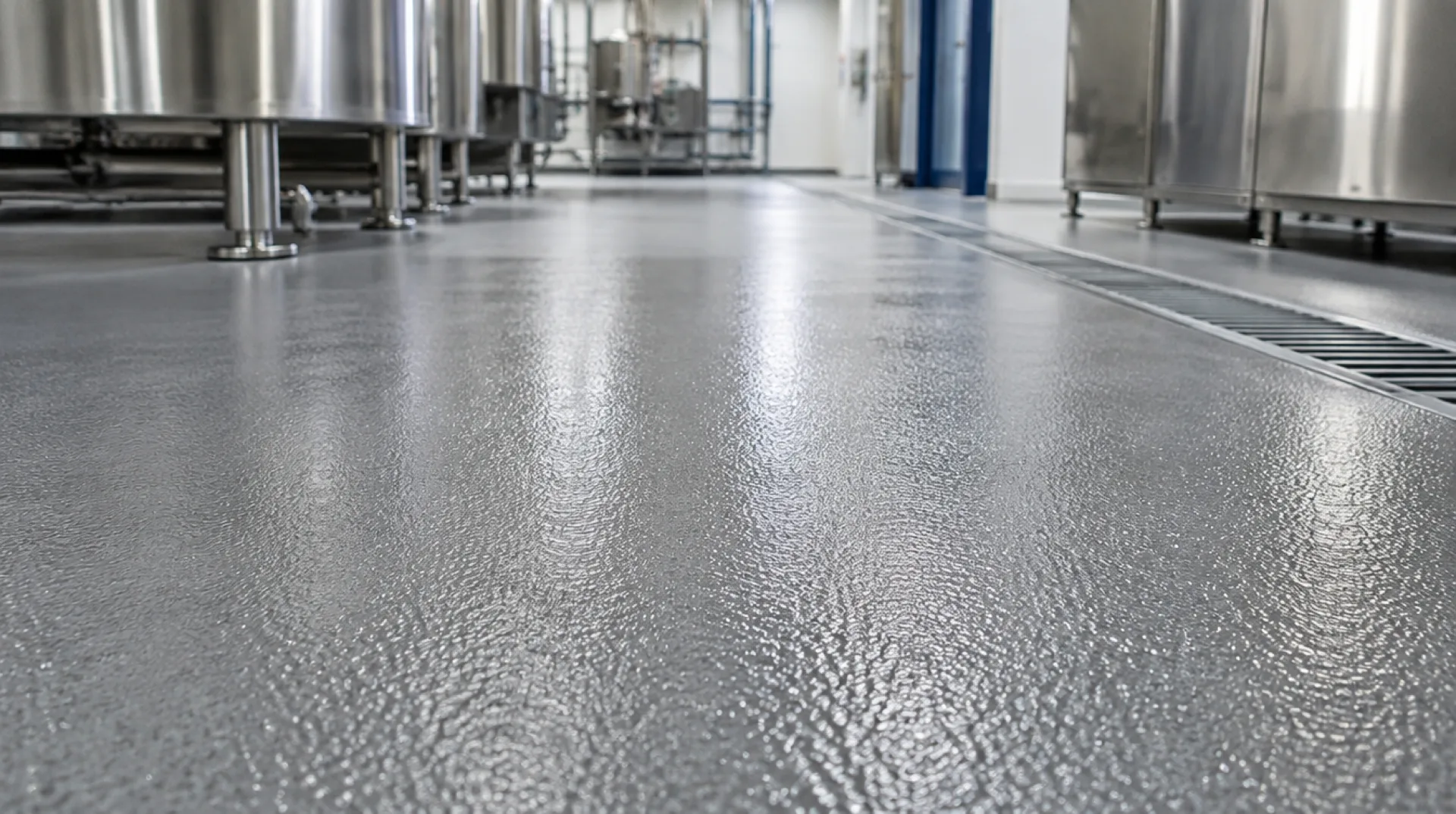
A urethane cement floor installed in a San Antonio commercial or industrial setting should carry a dynamic coefficient of friction (DCOF) of 0.60 or higher for any area exposed to water, grease, or other slip hazards - a threshold that a properly specified broadcast-aggregate urethane cement finish routinely exceeds, making it one of the most reliable options for demanding wet or greasy environments.
Why Slip Resistance Matters More for Urethane Cement Applications
Urethane cement is most often chosen for exactly the kind of environments where slip hazards are already elevated: food and beverage processing, commercial kitchens, breweries, and cold storage facilities where water, oil, or product residue regularly ends up on the floor. In these settings, slip-and-fall incidents are a leading cause of workplace injury claims, which makes the floor's actual measured slip resistance - not just a general assumption that "textured means safe" - a critical part of the specification rather than an afterthought.
How Slip Resistance Is Actually Measured
The current industry standard for measuring wet slip resistance is the dynamic coefficient of friction (DCOF), tested according to the ANSI A137.1 wet DCOF test method, which uses a standardized device to simulate a shoe sliding across a wetted floor surface and produces a numeric score. A DCOF of 0.42 is often cited as a general minimum for level walkway surfaces, but for consistently wet or greasy commercial and industrial floors, a considerably higher rating of 0.60 or above is the more appropriate benchmark, and it's the number worth asking a contractor for directly rather than accepting a vague "slip-resistant" description without supporting data.
Aggregate Broadcast Options and Their Slip Ratings
| Finish Type | Texture Level | Typical DCOF | Best For |
|---|---|---|---|
| Smooth trowel | Minimal | ~0.35-0.45 | Dry storage, offices |
| Light broadcast | Light texture | ~0.50-0.60 | Light-moisture production areas |
| Medium aggregate | Moderate texture | ~0.60-0.70 | Food processing, kitchens |
| Heavy aggregate | Aggressive texture | 0.70+ | Wash-down areas, cold storage |
More texture isn't always better: an overly aggressive slip-resistant finish in a food-handling area can trap debris and become harder to fully sanitize, so the right texture level balances slip safety against the facility's actual cleaning and sanitation requirements.
Slip Resistance for Cold Storage and Meat Processing
Cold storage and meat processing floors face a compounded slip risk: persistent moisture and fat residue combined with occasional ice formation near freezer thresholds or during defrost cycles. Our detailed guide on urethane cement for meat processing and cold storage covers additional considerations specific to these facilities, including thermal-shock resistance alongside slip resistance, since both properties matter simultaneously in this kind of demanding, temperature-variable environment.
Balancing Slip Resistance With Thermal Performance
For facilities that cycle between wash-down cleaning at warm temperatures and cold storage operation, slip resistance can't be evaluated in isolation from a urethane cement system's thermal-shock performance, since a coating that handles one requirement well but fails under repeated temperature cycling will eventually crack or delaminate regardless of how well its texture performs when new. Our comparison of urethane cement vs. epoxy thermal shock resistance explains why urethane cement is generally the stronger choice for facilities that need both properties working together rather than treating slip resistance and thermal performance as separate, unrelated specifications.
Specifying the Right Texture for Different Zones
Not every zone in a commercial or industrial facility needs the same slip-resistance level, and over-specifying an aggressive texture facility-wide adds unnecessary cost and cleaning burden in areas that don't need it. Wet processing floors, wash-down bays, and areas immediately around floor drains warrant the heaviest aggregate broadcast, while adjacent dry storage, office space, or loading dock aprons can use a lighter texture or even a smooth finish. A facility walkthrough with a contractor who maps out actual moisture and traffic patterns zone by zone, rather than applying a single blanket specification across the whole floor, produces a more cost-effective and appropriately performing result.
Maintaining Slip Resistance Over the Floor's Lifespan
A urethane cement floor's slip resistance can degrade gradually over years of heavy traffic and cleaning, particularly in zones with aggressive chemical wash-down or acidic cleaning agents that can slowly wear down the aggregate texture at the surface. Facilities should periodically re-test DCOF in high-risk zones - particularly after several years of heavy use - rather than assuming the original installation rating still holds indefinitely, since a texture that has worn smooth from years of foot and cart traffic no longer provides the same slip protection it did when new, even though the floor may look structurally intact.
Specify the Right Slip Rating for Your Facility
We map moisture and traffic zones and specify the right urethane cement texture for each area of your San Antonio facility.
Request a Free QuoteHow Urethane Cement Compares to Epoxy for Slip Resistance
Standard epoxy can be broadcast with aggregate to improve slip resistance as well, but urethane cement's greater film thickness and more durable matrix generally holds an aggregate broadcast texture longer under heavy wash-down and thermal cycling than an equivalent epoxy system. For facilities directly comparing the two, understanding our full urethane cement flooring service offering alongside a standard epoxy quote helps clarify whether the added upfront cost of urethane cement is justified by the specific slip, thermal, and durability demands of the space in question, or whether a well-specified epoxy system would perform adequately for a lower-demand area.
Documentation and Compliance Considerations
Many food-processing and commercial kitchen facilities operate under health department or industry-specific inspection requirements that reference slip resistance, even if not always by a specific numeric DCOF standard. Keeping documentation of the installed system's tested or manufacturer-rated slip resistance on file gives a facility manager something concrete to reference during an inspection or after an incident, rather than relying on a general assurance that the floor "should be" slip-resistant. Requesting this documentation as part of the original installation, and keeping it with other facility maintenance records, is a small step that can matter significantly if slip resistance is ever questioned after an incident.
OSHA and Insurance Considerations for Slip Ratings
While OSHA doesn't mandate a specific numeric DCOF value, employers are required under general duty obligations to maintain a workplace free of recognized slip hazards, and a documented, appropriately specified slip-resistant floor is one of the clearer ways to demonstrate that obligation has been met proactively. Workers' compensation insurers also increasingly ask about floor slip-resistance measures during underwriting or after a claim, and facilities that can point to a specific installed system with a known DCOF rating are generally in a stronger position than those relying on a general description of the floor as "textured" or "non-slip" without supporting data. Building this documentation into the flooring project from the start, rather than scrambling to produce it after an incident, is a small additional step during installation that pays off if the floor's performance is ever questioned.
Choosing an Installer With Slip-Rating Experience
Not every flooring contractor routinely works with facilities that have formal slip-resistance requirements, and the difference shows up in how they approach the specification conversation. A contractor experienced with food processing, cold storage, or other high-risk wet environments will typically ask about the facility's specific moisture patterns, cleaning chemicals, and any existing inspection or compliance requirements before recommending a texture level, rather than defaulting to a single standard finish across every project regardless of use case. Asking a prospective contractor directly what DCOF rating their recommended finish typically tests at, and whether they can provide manufacturer documentation supporting that number, is a straightforward way to gauge their actual experience with slip-critical installations versus general flooring work.
Signage and Housekeeping Alongside Floor Specification
Even a well-specified, properly rated slip-resistant floor works best as part of a broader safety approach rather than a standalone fix. Wet-floor signage during and immediately after cleaning, prompt spill response protocols, and appropriate footwear policies for staff working in consistently wet zones all remain relevant regardless of how high a floor's DCOF rating tests, since no floor surface eliminates slip risk entirely on its own. Facilities that treat the flooring upgrade as one part of a combined housekeeping and safety program, rather than a single fix that replaces the need for ongoing spill management, generally see better real-world safety outcomes than those relying on the floor coating alone.