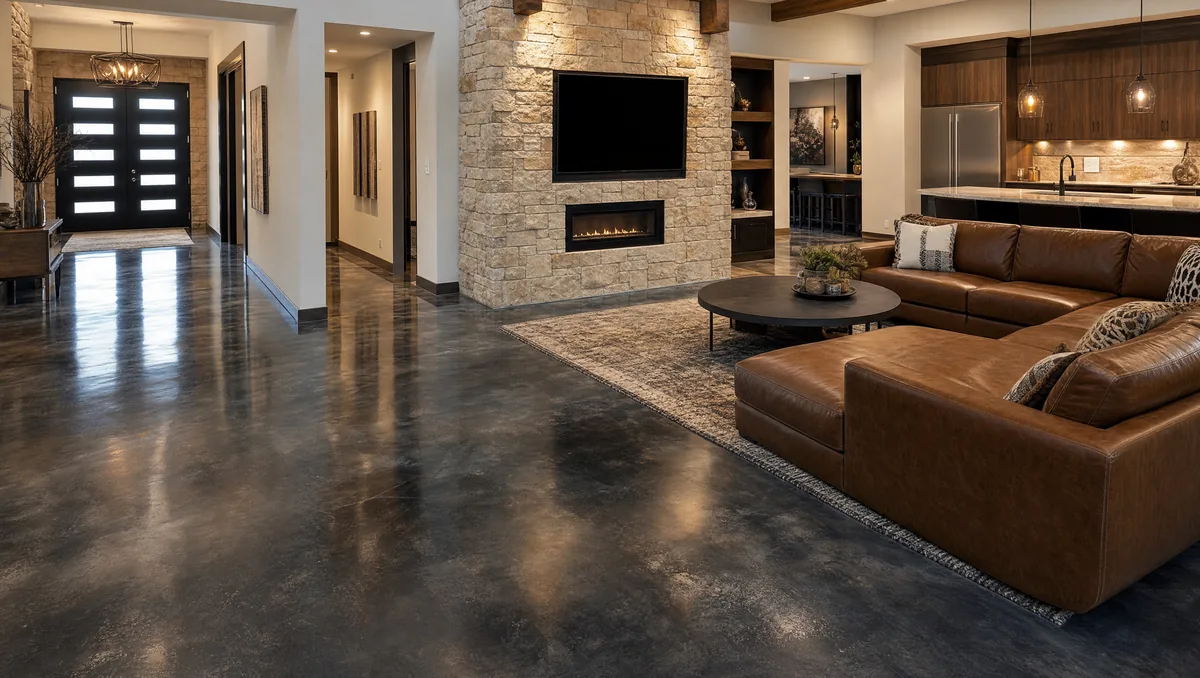
Stained concrete and epoxy overlap far more on install price than most comparisons admit. A sealed stained concrete floor in San Antonio typically runs $3 to $8 per square foot installed. An epoxy floor coating runs $3 to $12 depending on the system, with residential garage work usually between $3 and $6 and commercial systems between $4 and $8. A basic single-color stain and a thin roll-applied epoxy can land within a dollar of each other.
So the install is rarely what decides it. What decides it is the maintenance cycle, and that is where the two genuinely diverge. This guide covers both, including the reseal and recoat rhythm that most comparisons leave out entirely.
The short answer, by budget horizon
Over a three to five year horizon the two are close enough on total spend that appearance and slab condition should make the decision for you. Over ten years and beyond, epoxy pulls ahead on cost in any space with real traffic, because its maintenance cycle is several times longer.
The reason is structural rather than a matter of brand or product quality. Staining colors the concrete itself and then relies on a thin sealer to protect it. Epoxy builds a measurable film on top of the concrete. A sealer is a consumable that gets renewed every year or two in traffic. A film is a wear layer that gets renewed in years, not annually. That single difference drives almost everything else in the comparison.
Note also that the two price bands are not interchangeable at the same point. At $4 per square foot you are choosing between a decent stain and a thin epoxy. At $10 you are choosing between a high-end decorative stain system and a full broadcast flake epoxy. Compare like builds, not like budgets.
What you are actually comparing
Stained concrete is a coloring process, not a covering. Acid or water-based stain reacts with or penetrates the slab, and the result is sealed with an acrylic, urethane or polyaspartic sealer. The concrete remains the wearing surface. You can read a fuller treatment of the finishes and styles available in our guide to stained concrete floors in San Antonio.
Epoxy is a coating system. A primer bonds to the prepared slab, a body coat builds thickness, and a topcoat carries the abrasion and chemical duty. The result is a continuous film measured in mils, and the film rather than the concrete takes the wear. Our epoxy floor coating page sets out the system builds available.
Both require the same starting point, and this is where quotes most often diverge without anyone noticing. Both need mechanical surface preparation. Neither can be installed over a slab that fails a moisture test. If one quote includes grinding and moisture testing and another does not, you are not comparing two finishes, you are comparing two different scopes of work.
Installed cost per square foot: stained concrete
Most San Antonio stained concrete installs fall between roughly $3 and $8 per square foot installed. The spread is wide because the term covers very different amounts of work.
At the lower end sits a single-color acid stain on a sound, clean slab with a straightforward acrylic sealer. At the upper end sits multi-color work, dye accents, saw-cut patterns or scored borders, and a higher-grade urethane or polyaspartic sealer that holds up better under traffic and UV.
What pushes a stain quote upward is almost always the slab rather than the color. Staining is translucent, so it reveals everything underneath it: patches, old adhesive residue, power-trowel burnish marks, discoloration from previous coverings, and cracks. Remediating those costs money, and on a poor slab the remediation can exceed the staining. On a badly compromised slab, staining is often simply the wrong choice, because the finish will advertise every defect you were hoping to hide.
Installed cost per square foot: epoxy
Epoxy runs roughly $3 to $12 per square foot installed across the full range of systems. In practice that splits into two bands: residential garage work typically falls between $3 and $6, and commercial or industrial systems between $4 and $8, with decorative metallic and specialty builds at the higher end.
A thin roll-applied solid color sits at the bottom. A full broadcast flake or quartz system with a polyurethane or polyaspartic topcoat sits toward the top. A troweled mortar system for heavy industrial duty sits above the band entirely. The variable that moves the number most is mil thickness, because thickness drives both material volume and the number of coats and cure days required.
Unlike staining, epoxy is forgiving of a mediocre slab. It is opaque, it fills minor surface irregularities, and it can be installed over patched and repaired concrete without the repairs telegraphing through. For a slab in poor cosmetic condition, that forgiveness is worth real money, and it sometimes makes the nominally more expensive option the cheaper project. For a fuller breakdown of what moves an epoxy number, see our guide to epoxy flooring costs in San Antonio.
Side-by-side cost and performance
| Factor | Stained concrete | Epoxy coating |
| Typical installed cost | $3 to $8 per sq ft | $3 to $12 per sq ft |
| Wearing surface | The concrete itself | The applied film |
| Maintenance cycle | Reseal every 1 to 3 years in traffic | Topcoat refresh every 5 to 10 years |
| Cost per maintenance event | A fraction of the install | More than a reseal, far less than a new floor |
| Tolerance of a poor slab | Low, reveals defects | High, conceals defects |
| Chemical resistance | Limited, sealer dependent | Good to excellent by system |
| Repairing localized damage | Difficult to blend invisibly | Patch and recoat the area |
| Downtime at install | Shorter | Longer, cure driven |
| Appearance | Variegated, translucent, natural | Uniform, opaque, controllable |
Lifetime cost: reseal cycles against recoat cycles
This is the part that decides the comparison, and it is the part most quotes never show you.
A stained floor in a residential setting with light traffic may hold its sealer for two to three years before it needs renewing. In a retail entry, a restaurant floor or anywhere carts and grit move across it daily, that interval compresses toward a year. Each reseal is inexpensive on its own, but it recurs, it requires the space to be cleared and closed briefly, and the cumulative cost adds up quietly over a decade.
An epoxy floor with a sacrificial topcoat behaves differently. The topcoat absorbs the wear and can be abraded and renewed without disturbing the body coat underneath, typically somewhere in the five to ten year range depending on traffic. Each event costs more than a reseal, but there are far fewer of them.
Run those two cycles out over twenty years and the ranking usually inverts, even where the two installs cost about the same. The stained floor has absorbed six to twelve reseals. The epoxy floor has absorbed two or three topcoat renewals. Exactly where the crossover lands depends on your traffic, but the direction of travel is consistent: the harder the floor is used, the sooner epoxy becomes the cheaper option.
In a low-traffic residential room, the crossover may never arrive within the time you own the building, which is a legitimate reason to choose stain. In a commercial space with daily foot and cart traffic, it arrives early enough to matter to a budget. Our guide to commercial stained concrete floors covers where stain still makes sense on the commercial side.
A worked example over twenty years
Numbers in the abstract are hard to act on, so here are two scenarios on the same 800 square foot floor, using the mid-points of the ranges above. Treat these as illustrative arithmetic rather than a quote, because your slab condition and traffic will move both columns.
Scenario one, a residential living area with light traffic. Stained concrete installs at the lower middle of its band and holds its sealer for roughly three years at a time. Over twenty years that is the original install plus six reseals. Epoxy installs higher and needs its topcoat renewed perhaps twice in the same period. Because the traffic is light, the stain's reseal interval stays long and its cumulative maintenance stays modest. Stain finishes the twenty years as the cheaper floor, and it also delivers the look most people want in a living space. Stain is the right answer here.
Scenario two, a retail floor with daily foot and cart traffic. The same stained floor now needs resealing closer to annually, because grit and wheels abrade a thin sealer quickly at entries and along traffic lanes. Over twenty years that is the install plus something in the range of twelve to fifteen reseals, each one requiring the area to be cleared and closed for a day. The epoxy floor absorbs the same two or three topcoat renewals it would have anyway. Epoxy finishes well ahead on total spend, and considerably further ahead once you price the lost trading hours that each stain reseal costs you.
That second column is the one most comparisons omit entirely. Maintenance is not only a materials and labor cost, it is a downtime cost, and in a commercial setting the downtime frequently exceeds the invoice. A floor that needs attention once a year is a different operational commitment from one that needs it twice a decade, regardless of what the two installs cost on day one.
Durability, slip resistance and repairability
On durability, epoxy is the more robust surface in almost any measurable sense. It resists chemical attack better, it takes impact better, and it does not depend on a thin sealer for its protection. Stained concrete is as hard as the slab beneath it, which is considerable, but its protection is only as good as the sealer currently on it.
On slip resistance, neither has an inherent advantage, because both are specified. A smooth gloss sealer over stain and a smooth gloss epoxy topcoat are both slick when wet. Both can carry anti-slip aggregate, and both should where water is likely.
On repairability the picture is more mixed than people expect. Epoxy damage is straightforward to address: abrade the area, patch and recoat, and with a reasonable color match the repair disappears into the floor. Stain damage is harder, because the color lives in the concrete and a new stain application on a repaired area rarely matches the surrounding reaction. In practice, a damaged stained floor is often resealed overall rather than spot repaired, and a deep gouge may be permanent.
Where each one belongs
Choose stained concrete when appearance is the priority, the slab is in sound cosmetic condition, traffic is light to moderate, and you accept a recurring maintenance rhythm. Residential living areas, patios, offices, boutique retail and anywhere you want a variegated natural look are its natural home.
Choose epoxy when the floor has a job to do. Garages, workshops, warehouses, commercial kitchens, clinics, auto and manufacturing space, and anywhere there are chemicals, wheels, point loads or wash-down. Also choose it when the slab is cosmetically poor, because concealing defects is worth paying for.
If you are weighing a third option, the comparison between a ground and polished finish and a coating is covered in our guide to polished concrete versus epoxy flooring.
Can you combine them?
Yes, and it is a common request. A stained slab can be sealed with a clear epoxy or a clear polyaspartic instead of a conventional acrylic sealer, which gives you the variegated look of stain with a thicker, tougher protective layer over the top.
It costs more than a standard sealed stain and less than a full opaque epoxy build, and it lengthens the maintenance interval considerably. The constraint is compatibility: the stain must be fully cured and any residue neutralized, and the clear coat has to be specified to bond over the stain system used. This needs to be planned before the stain goes down rather than decided afterward.
What changes the math in San Antonio
Three local factors move these numbers more than most people anticipate.
The first is slab condition and age. A lot of local housing stock and light commercial space sits on slabs that have moved, cracked and been patched. That pushes decisively toward epoxy on cosmetic grounds and adds remediation cost to any stain quote.
The second is sun exposure. Anything near a west-facing opening, a glass storefront or an exterior transition takes serious UV load here. Standard acrylic sealers and clear epoxies both amber and chalk under that exposure. A polyaspartic or aliphatic urethane topcoat holds color far better, and specifying one adds cost to either option.
The third is heat during installation. High ambient temperature shortens pot life and working time for epoxy, which in practice means earlier starts and smaller batches rather than a faster schedule. Stain is less sensitive to this, which occasionally makes it the more practical choice on a tight summer timeline.
How to get a number you can actually compare
Price neither option from a square footage you estimated yourself. Have the area measured, have the slab moisture tested, and insist that both quotes itemize surface preparation separately from the finish. A stain quote and an epoxy quote are only comparable once you can see that both include the same preparation scope and the same testing.
Then ask one more question of each: what is the maintenance interval, and what does each maintenance event cost? With those two numbers you can build the twenty year figure yourself, and that figure is usually the one that decides it.
Frequently asked questions
Is stained concrete cheaper than epoxy?
Not reliably. Stain runs about $3 to $8 per square foot installed and epoxy $3 to $12, so the bands overlap and a basic stain and a thin epoxy cost much the same. Stain has the lower ceiling, but over time its shorter reseal cycle often makes it the more expensive floor to own.
Which lasts longer, stained concrete or epoxy?
A correctly specified epoxy builds a thicker wear layer, so it generally goes longer between interventions. Stained concrete relies on a thin sealer that is cheaper to renew but needs renewing more frequently, particularly in traffic.
How often does stained concrete need resealing?
Typically every one to three years, with the shorter interval applying to traffic areas and anywhere exposed to sun or moisture. That recurring cost is what drives the lifetime comparison against epoxy.
At what point does epoxy become the cheaper option?
Once enough reseal cycles have accumulated to overtake the higher initial outlay. In a high-traffic commercial space the crossover arrives within several years. In a low-traffic residential room it may not arrive at all within your ownership.
Can you put epoxy over stained concrete?
Yes, as a clear coat rather than an opaque build. A clear epoxy or polyaspartic over cured stain keeps the variegated look while adding a thicker protective layer. The stain must be fully cured and the clear coat specified to bond over that stain system.