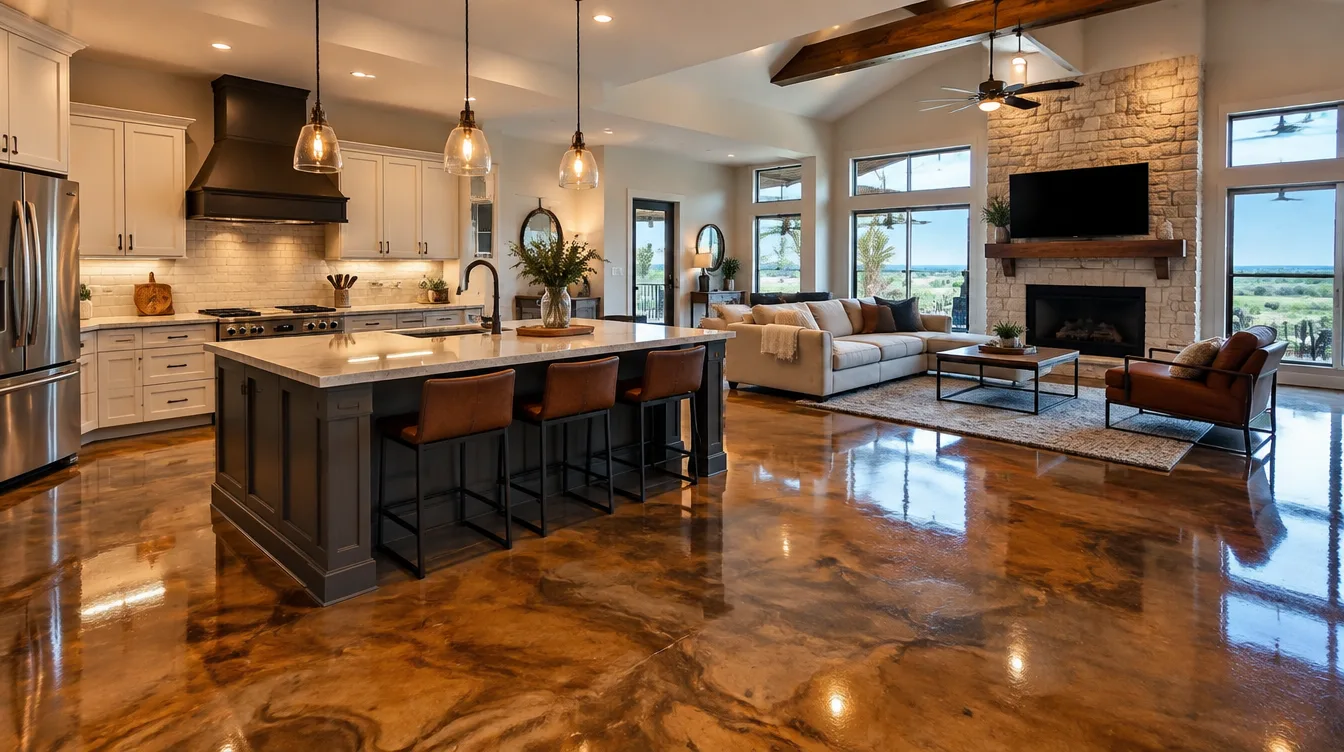
Residential epoxy flooring suits the utility and wet rooms of a San Antonio home, meaning laundry rooms, mudrooms, pantries, kitchens, basements and garages, and it is the wrong answer for bedrooms, most living areas and any floor that is not a sound concrete slab. The coating is only as good as the slab under it, so the deciding factors in every room are the concrete's moisture condition and how much you mind a hard, cool surface underfoot. For how the systems themselves are built and priced, start with our epoxy floor coating overview, then use this guide to decide which rooms of your house belong on the list.
Quick answer: which rooms in a home suit a resin floor and which do not
A resin floor works in rooms that are small, wet or hard-used and sit on a concrete slab, and it works poorly in rooms where comfort, warmth and sound matter more than cleanability. That sorts a typical San Antonio house into three groups. Laundry rooms, mudrooms, pantries and garages are easy wins. Kitchens and basements are good candidates that depend on the slab passing a moisture test. Bedrooms, living rooms and anything built over a wood subfloor are usually better served by something else.
Most San Antonio homes are built on a concrete slab, which is the single fact that makes epoxy a realistic option here at all. In a house with a crawlspace or a framed floor, a rigid coating has nothing stable to bond to and the conversation ends before it starts. In a slab-on-grade house the question becomes room by room, and the sections below take them in the order most homeowners ask.
Two guardrails apply everywhere. First, a coating cannot fix a slab that is actively passing moisture, so the slab is tested before anything is specified. Second, a coating is not a finished floor in its own right. It takes on the temperature, hardness and sound of the concrete beneath it, which is why the verdict changes from room to room.
Laundry rooms, mudrooms and pantries: the easiest wins
Laundry rooms, mudrooms and pantries are the strongest fit for a residential epoxy floor because they are small, they get wet or dirty, and nobody stands in them barefoot for long. A seamless surface with no grout lines and a coved edge where the floor meets the wall keeps water, grit and detergent spills from reaching the slab edge or the baseboard.
Laundry rooms carry the highest water risk of the three. A failed supply hose or an overflowing washer puts standing water on the floor, and a sealed, seamless coating gives you time to deal with it. Mudrooms take the abrasion, since grit tracked in on shoes acts like sandpaper on a softer floor. A properly profiled slab with a flake broadcast hides that scuffing and adds texture. Pantries are the simplest of all: low traffic, occasional spills, and a surface that wipes clean.
Small rooms also expose the fixed-cost effect described in our guide to epoxy floor cost by square footage. A 60 square foot laundry room costs far more per square foot than a garage, because the crew still brings the same grinder and spends a full setup on a small area. Many homeowners get a better rate by coating the laundry room, mudroom and garage in a single visit.
For wet rooms, ask about slip resistance. The measure that matters is dynamic coefficient of friction, tested under ANSI A326.3 (the older static method is ASTM C1028), and a satin finish with fine aggregate in the topcoat gives a wet floor more grip than a polished gloss. Our post on epoxy floor slip resistance covers the aggregate options in more detail.
Kitchens: what works, and the grout-free argument
A kitchen can take an epoxy floor, and the strongest argument for it is that a continuous surface has no grout lines to trap food, grease and moisture. Tile is the usual kitchen floor, and its weak point is the grout, which stains, absorbs liquid and needs periodic sealing. A seamless coating removes that maintenance and wipes clean with a damp mop.
The constraints are comfort and substrate. Standing at a counter on bare concrete for an hour is harder on feet, knees and backs than standing on wood or cushioned vinyl, and a dropped glass will break on a coated slab just as it would on tile. Anti-fatigue mats at the sink and range handle most of that. The substrate matters more. An existing kitchen floor of tile, vinyl or wood has to come up completely, and the slab underneath then needs mechanical profiling and a moisture test before a coating is specified.
Moisture testing follows two common methods. ASTM F1869 uses calcium chloride to measure moisture vapor emission from the surface, and ASTM F2170 uses in-situ probes to measure relative humidity inside the slab. A slab that fails either one needs a moisture mitigation primer before the decorative system goes down, which adds cost and time. Skipping the test is the most common reason a kitchen floor blisters in its first year.
Open-plan homes raise a design question. A kitchen floor that flows into a living area looks seamless, but the living side then inherits the hardness and cool surface of the coating. Many owners continue the coating through the whole open space and use area rugs to soften seating zones, which is a reasonable approach as long as the decision is made on purpose.
Basements and below-grade slabs: the moisture condition that decides it
A basement or below-grade slab is a good candidate for epoxy only if it passes a moisture test, and that single result decides the whole project. Concrete in contact with soil takes up groundwater and releases it upward as vapor, and a coating applied over an active slab traps that vapor until it lifts the film.
The test comes first, not the color. A slab that tests dry can take a standard system. A slab that tests wet needs a vapor barrier or moisture-tolerant primer, and a slab with visible water intrusion needs the water source fixed before any coating goes on. Bexar County's expansive clay soils make this a common finding in older homes, so treat a basement quote that skips testing as incomplete. Our guide to moisture and basement epoxy floors walks through the testing and the mitigation options in detail.
Basements also raise a finishing-material choice. Tile and wood-look planks both trap moisture underneath and can hide a problem until it smells, while a seamless coating lets you see and clean the whole surface. Our comparison of basement floor epoxy vs tile breaks down that tradeoff, including cost and install time. The short version is that epoxy wins on moisture visibility and cleanability and loses on warmth, which is why basements that double as living space often get a coating with rugs rather than a bare slab.
If the basement is a workshop, storage area or laundry zone, the case for epoxy is straightforward. If it is a finished family room, the decision depends on how much cool, hard flooring you will accept.
Sunrooms, patios and anything exposed to direct Texas sun
Sunrooms and covered patios can take a coating, but direct sun changes which coating you choose. Standard epoxy is not UV stable. In sunlight it chalks and yellows over months, so any slab that gets direct sun through glass or open air needs a UV-stable topcoat, usually a polyaspartic or aliphatic urethane, over the epoxy body coat.
Heat is the second issue. A sunroom slab can run far warmer than an interior slab in a San Antonio summer, and a floor that expands and contracts with daily temperature swings is harder on a coating than one in a conditioned room. Installers work around this by timing application for cooler hours and using systems rated for the temperature range, which matters because epoxy cure speed and working time both change with slab temperature.
Fully outdoor patios are a separate category with their own concerns, including drainage, slip resistance when wet and freeze-thaw movement at joints. If you are weighing a coating for an open patio rather than an enclosed sunroom, our guide to outdoor epoxy patios in San Antonio covers the exterior conditions that change the specification.
A practical rule: if sun hits the floor for more than a few hours a day, ask the installer to name the topcoat and its UV rating before you sign. If the answer is plain epoxy, expect visible yellowing.
Where epoxy is the wrong answer in a house, stated plainly
Epoxy is the wrong answer in bedrooms, most living areas, any room over a wood subfloor, and any slab that is failing a moisture test and cannot be fixed. Here is why in each case.
Bedrooms and living rooms. A resin floor is as hard and as cool as the concrete underneath, and in rooms where you sit, lie down or walk barefoot that is the main objection. Carpet, wood or luxury vinyl are warmer and quieter, and a coating that looks good in a photograph can feel cold and echo in a real living room. Rugs and in-slab heating solve part of the problem, but at that point you are spending to compensate for the floor.
Framed or crawlspace floors. Epoxy needs a rigid, stable substrate. Plywood and joist floors flex with load and temperature, and a rigid coating over a flexing base cracks. This rules out second stories and pier-and-beam homes entirely.
Active moisture. A slab that keeps failing moisture tests, or shows active water intrusion, will not hold a coating no matter how good the product. The fix is on the water side first.
Rooms where sound matters. A hard surface reflects sound, so open rooms with high ceilings and no soft furnishings can sound loud and bright.
Homes where falls are a concern. A hard floor is less forgiving than a cushioned one for older residents or small children, and a slippery gloss finish raises that risk. If this applies to your household, the cushioned option is the safer answer.
Polished concrete is the alternative for living spaces on a sound slab, because it keeps the open, seamless look with no film to peel, though it shares the hardness. Our guide to polished concrete for home interiors covers when that route makes more sense than a coating.
Room by room comparison table: traffic, moisture risk, recommended system
| Room | Foot traffic | Moisture risk | Verdict | Recommended system |
| Laundry room | Low | High, from leaks and spills | Strong fit | Solid color or fine flake, coved edge |
| Mudroom | High, with grit | Moderate | Strong fit | Full flake broadcast, textured topcoat |
| Pantry | Low | Low | Strong fit | Solid color, clear topcoat |
| Kitchen | High | Moderate, slab test required | Good fit | Decorative flake or metallic, satin topcoat |
| Basement | Varies | High, test decides the project | Fit if slab passes | Moisture primer plus flake system |
| Sunroom | Moderate | Low, but high UV and heat | Fit with UV topcoat | Epoxy body, polyaspartic topcoat |
| Garage | High, with vehicles | Moderate | Strong fit | Flake with polyaspartic or urethane topcoat |
| Bedroom or living room | Moderate | Low | Usually not a fit | Carpet, wood or polished concrete |
Read the table as a starting point rather than a specification. Within any row, the slab's actual condition can change the verdict, and a measured on-site assessment replaces a general table.
How residential systems are specified and what they cost
Residential epoxy systems are usually thinner and more decorative than commercial ones, chosen for appearance and cleanability rather than heavy industrial loads. A typical home system is a primer, a pigmented body coat, a flake broadcast for color and texture, and a clear topcoat for wear and UV resistance. Commercial work specifies higher film builds and heavier preparation for forklifts and chemicals.
Standard residential garage epoxy in San Antonio typically runs $3 to $6 per square foot installed, and decorative or heavily repaired floors run higher. Small rooms price above that headline rate because of fixed setup costs. Preparation is the largest quality driver: diamond grinding to a defined profile, with ICRI 310.2R giving the CSP 1 to 9 scale installers use to describe how rough a prepared slab is, and adhesion verified where it matters with an ASTM D4541 pull-off test. A quote that says only "clean and prep" is missing the step that decides how long the floor lasts.
Garages are the most common residential install and have their own planning questions, which our garage pages cover in depth. This post stays on the rest of the house, so if the garage is your main interest, start with our garage floor epoxy cost guide and come back here for the interior rooms.
Frequently asked questions
Can you put epoxy flooring in a kitchen?
Yes, and a seamless resin floor removes the grout lines that trap food and moisture. The practical constraints are comfort underfoot, hardness, and making sure the slab passes a moisture test before any coating goes down.
Is epoxy flooring good for a whole house?
Rarely. It performs well in utility spaces, kitchens, basements and garages, but most households want something softer and warmer in bedrooms and living areas. A mixed approach is more common than coating everything.
Does epoxy flooring feel cold or hard to walk on?
It is as hard and as cool as the concrete underneath, because it is a coating rather than a floor in its own right. In living spaces that is the main objection, and area rugs or in-slab heating are the usual answers.
Can epoxy go over an existing home floor?
It needs a sound concrete substrate. Tile, vinyl or wood have to come up, and the slab underneath then needs mechanical profiling and a moisture test before the coating is specified.
Is residential epoxy different from commercial epoxy?
Usually yes. Residential installs tend toward thinner decorative systems chosen for appearance, while commercial work specifies higher mil builds and heavier prep for traffic and chemical exposure.
If you are deciding which rooms in your home suit a coating, call (830) 355-3303 for a free on-site measure and written quote, or read our epoxy floor coating page to compare systems before you book.