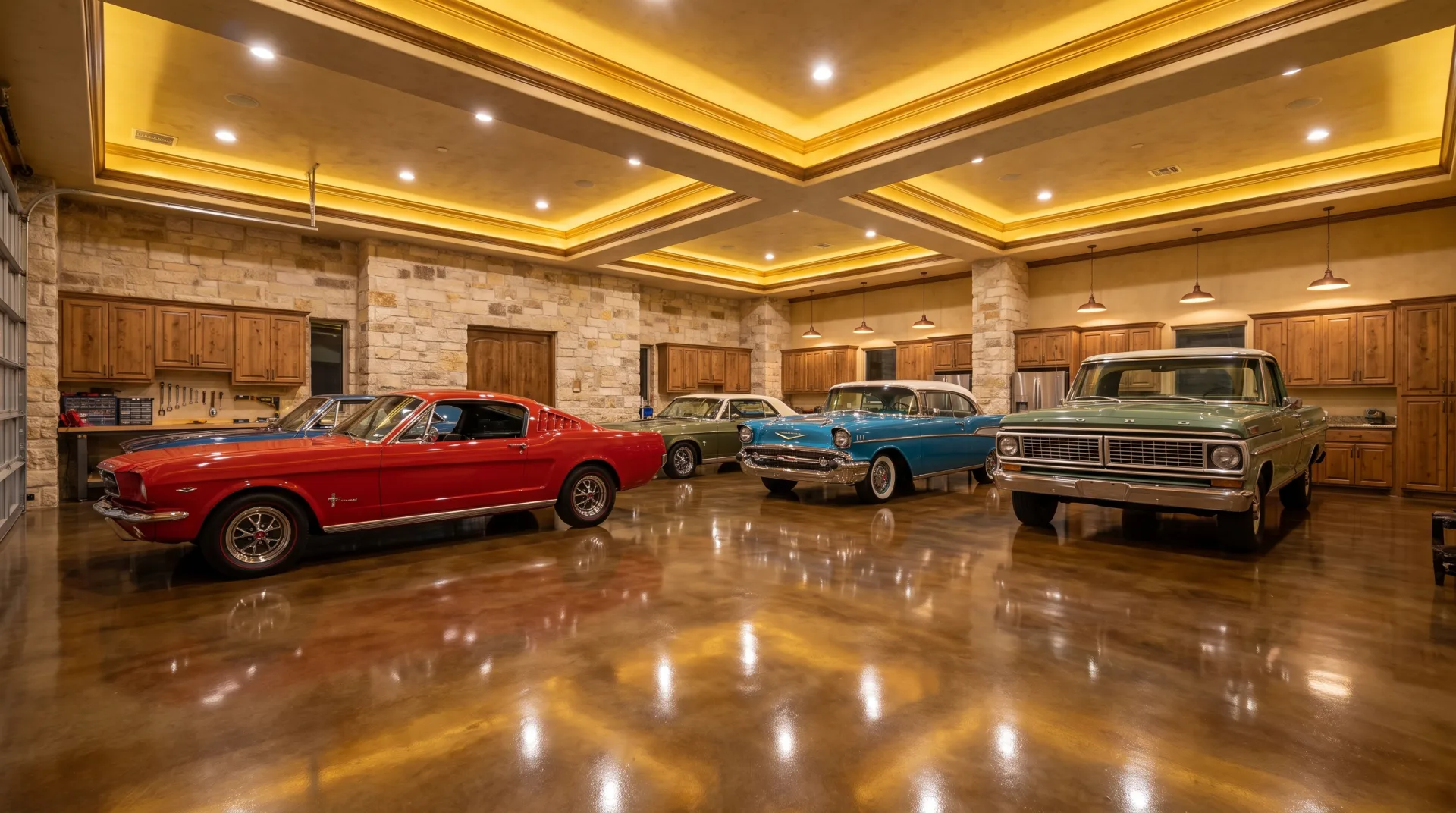
An epoxy garage floor gives San Antonio classic car collectors a showroom-quality backdrop that also protects a serious investment - chemically resistant to oil, brake fluid, and coolant, durable enough for jack stands and rolling tool chests, and finished in a level of gloss that makes a multi-car collection look like a private showroom rather than a utility garage. For collectors, the floor isn't an afterthought; it's part of how the collection is displayed and preserved.
Why Collectors Choose Epoxy Over Bare or Painted Concrete
Bare concrete is porous and stains permanently from the kind of fluid drips that are simply part of owning older vehicles - a small transmission seep or brake fluid drip left overnight can leave a mark bare concrete never fully releases. Painted concrete fares slightly better but chips and wears through in high-traffic spots far faster than a true 2-part epoxy system, which chemically bonds to the slab and resists both staining and abrasion. For a collector rotating vehicles in and out, hosting fellow enthusiasts, or simply spending serious time in the garage working on a project car, epoxy is the only surface that holds up to that use while still looking genuinely polished.
Showroom Finishes: Metallic, Flake, and High-Gloss Solid Color
Collector garages tend to favor one of three finish styles. Metallic epoxy creates a swirling, marbled, almost three-dimensional effect using metallic pigments suspended in the coating - a popular choice for collectors wanting a genuinely custom, gallery-like floor. Flake broadcast systems scatter colored chips into the base coat for a textured, multi-tone look with excellent durability and slip resistance. A high-gloss solid color system, meanwhile, delivers the cleanest, most true showroom aesthetic - often paired with a base color that complements the cars themselves or the homeowner's broader design scheme.
Comparing Finish Options for a Collector Garage
| Finish Type | Look | Best For |
|---|---|---|
| Metallic Epoxy | Marbled, dimensional | Statement showroom garages |
| Flake Broadcast | Textured, multi-tone | Durability + visual interest |
| High-Gloss Solid | Clean, uniform, reflective | Classic showroom aesthetic |
Gloss level affects both look and practicality: a higher-gloss finish shows the cars' reflections dramatically but also shows dust and fingerprints more readily, while a satin finish trades some visual drama for lower-maintenance day-to-day upkeep.
Chemical Resistance: Protecting the Floor From Real Garage Use
A collector garage sees exposure that a typical daily-driver garage doesn't - carburetor cleaner, brake cleaner, penetrating oils, and old fuel from a project car's tank are all more aggressive than the occasional oil drip a modern commuter car might leave. A properly cured 2-part epoxy system resists all of these common automotive chemicals, meaning a spill during a repair session wipes away rather than etching or staining the floor. This chemical resistance is one of the most practical, if less glamorous, reasons collectors specifically choose epoxy over decorative concrete stain or paint alternatives that lack the same resistance.
Weight, Jacks, and Lift Considerations
Collectors working on vehicles regularly want reassurance that a coated floor won't compromise safety under jack stands or a vehicle lift. The epoxy coating itself doesn't change the concrete slab's structural load rating - a floor engineered to support a lift before coating supports the same load after, since the coating is a thin surface layer rather than a structural element. The coating does, however, protect the surface immediately around jack stand feet and lift posts from the concentrated wear and occasional metal-on-concrete contact that these points see repeatedly. Our epoxy garage floor service page covers the systems we install for San Antonio garages, from single-car spaces to large multi-bay collector garages.
Ready to Give Your Collection a Showroom Floor?
We'll help you choose a finish that matches your collection's style and holds up to real garage use.
Request a Free QuoteChoosing Colors That Complement the Collection
Beyond durability, color and finish choice affects how the cars themselves photograph and present in the space. Darker floor tones tend to make brighter-colored classics pop more dramatically, while a lighter or metallic silver-toned floor can read as a cleaner, more neutral gallery backdrop that doesn't compete visually with the vehicles. Collectors building a garage specifically for displaying and photographing their collection - for social media, insurance documentation, or eventual resale - often work with their installer to preview a few color options against their actual cars before finalizing, since the interplay between floor tone and paint color varies more than swatches alone suggest. Our guide on metallic epoxy floor designs in San Antonio goes deeper into the specific color and pattern options available within the metallic system.
Budgeting for a Collector-Grade Floor
Collector garages often run larger than a standard two-car space, and the choice of a premium finish like metallic epoxy carries a higher per-square-foot cost than a basic solid color system. Getting an accurate quote means walking the installer through the full garage footprint, any planned lift or workspace zones that might need particular attention, and the specific finish under consideration, since metallic and elaborate flake systems typically cost more than a straightforward single-color install. Our post on two-car garage epoxy floor cost in San Antonio gives a useful cost baseline to scale up from when budgeting a larger collector space.
Maintaining a Showroom Finish Long-Term
A showroom-quality epoxy floor stays that way with fairly simple ongoing care: regular sweeping to prevent grit from scratching the gloss surface, prompt cleanup of any fluid drips rather than letting them sit, and avoiding dragging metal jack stands, tool chests, or engine stands directly across the floor without protective pads underneath. Periodic damp mopping with a pH-neutral cleaner - rather than harsh degreasers not intended for coated floors - keeps the gloss looking fresh for years. Collectors who treat floor care as part of their overall car care routine typically get the longest visual life out of a premium finish.
Planning a Multi-Bay Collector Space From the Ground Up
Collectors building a dedicated garage from scratch, rather than retrofitting an existing space, have an opportunity to plan the floor system alongside other design decisions rather than treating it as an afterthought once construction is finished. Coordinating floor color and finish with planned lighting - track lighting, LED strip lighting along walls, or skylights - matters more than many builders expect, since certain metallic and high-gloss finishes reflect light dramatically differently depending on the fixture type and placement overhead. Collectors working with an architect or builder on a new garage should loop in their epoxy installer during the design phase specifically to discuss lighting plans, drainage slope for any wash-down area, and electrical outlet placement relative to planned display zones, since moving conduit or outlets after the slab is poured is far more disruptive than accounting for them upfront.
Ceiling height and natural light also influence which finish reads best in a given space. A garage with high ceilings and abundant natural light tends to showcase a dramatic metallic swirl finish particularly well, since the additional light plays across the pattern's depth and dimension. A lower-ceilinged, more enclosed space often looks cleaner and more intentional with a simpler high-gloss solid color, which doesn't compete visually with a more constrained room. Walking the actual space with samples, rather than deciding purely from photos of other installations, helps collectors avoid choosing a finish that looks stunning in a showroom photo but doesn't suit their specific garage's proportions and lighting.
Working With an Installer Who Understands Collector Priorities
Not every flooring contractor approaches a collector garage the same way they'd approach a standard residential install, and that difference shows up in the details. An installer experienced with collector clients typically asks more specific questions upfront - what vehicles will be stored, whether any have known fluid leaks that inform prep priorities, whether a lift is planned now or in the future, and what the homeowner's timeline looks like around any car shows, appraisals, or insurance photography that might depend on the floor being finished. This level of specificity in the initial consultation is generally a good sign that the installer understands a collector garage is a different project than a standard two-car garage refresh, and will plan the prep, scheduling, and finish selection accordingly rather than applying a one-size-fits-all approach.