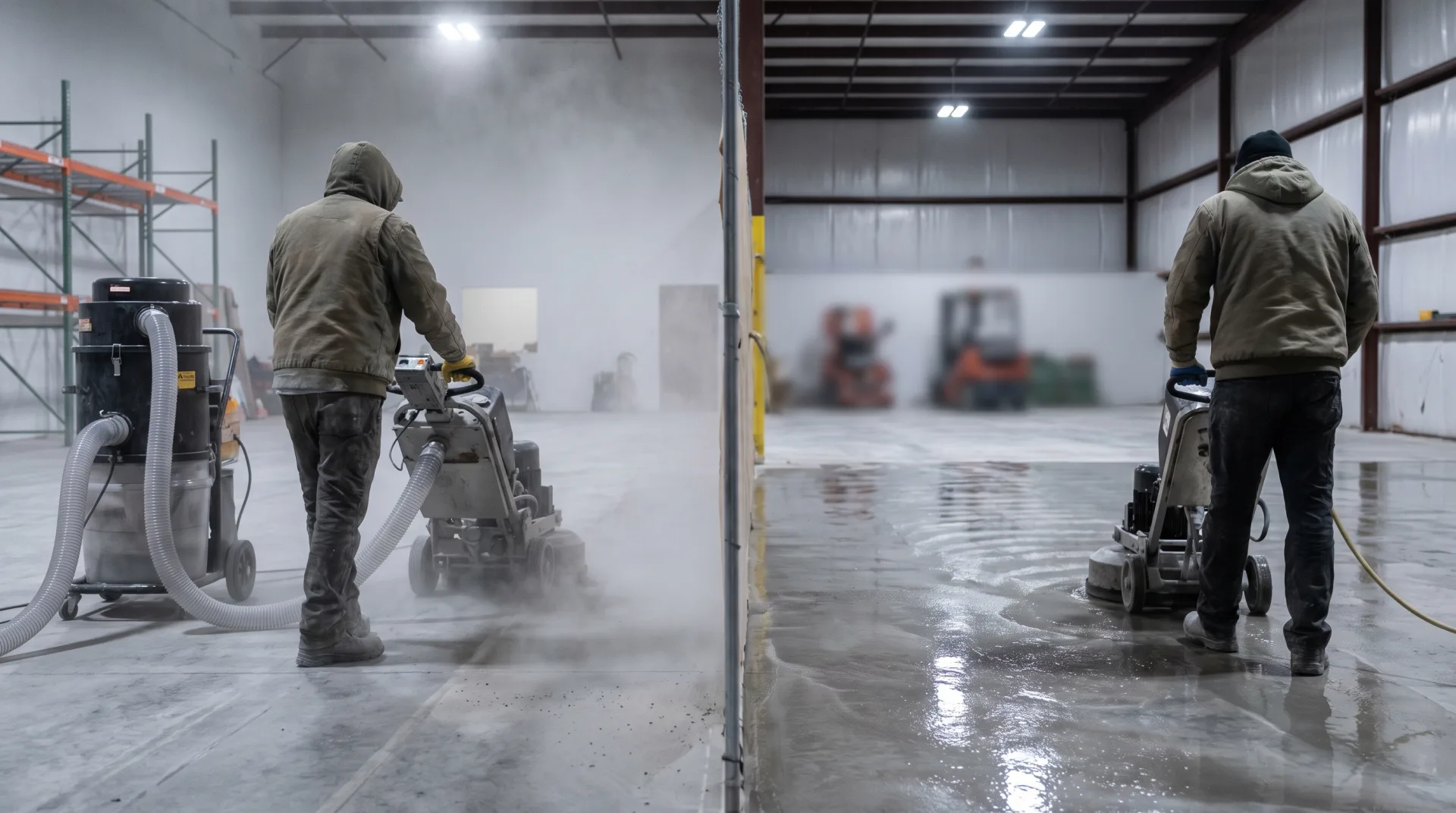
Dry polishing has become the default method most San Antonio contractors use for concrete polishing today, thanks to modern HEPA-filtered dust-extraction equipment that eliminates the mess and disposal concerns wet polishing involves, while producing a comparable finish quality. Wet polishing still has its place in certain outdoor or heavy-grinding scenarios, but for the majority of residential and commercial polishing jobs, dry has become the practical default.
How Dry Polishing Works
Dry polishing uses diamond-tooled grinding equipment fitted with a vacuum shroud connected to a HEPA-filtered dust extractor, capturing concrete dust at the source as it's generated rather than letting it become airborne. The process moves through progressively finer diamond grits, the same fundamental sequence as wet polishing, but without introducing water at any stage. This keeps the work area dry throughout, which matters significantly for indoor or occupied spaces where water intrusion into adjacent areas, moisture concerns for the slab itself, or extended drying time before the space returns to normal use would all be problems.
How Wet Polishing Works
Wet polishing uses the same progressive diamond-grit sequence but introduces water during grinding, primarily to cool the diamond tooling and control dust by keeping it wet rather than airborne. This method produces a slurry - a mix of water and ground concrete particulate - that needs to be managed and disposed of properly during the job, and the work area stays wet throughout the process, requiring time to dry before it's ready for normal use or subsequent treatment like sealing.
Comparison: Dry vs. Wet Polishing
| Factor | Dry Polishing | Wet Polishing |
|---|---|---|
| Dust control | HEPA vacuum extraction | Water suppression |
| Mess/cleanup | Minimal, no slurry | Slurry disposal required |
| Indoor/occupied use | Well suited | More disruptive |
| Finish quality | Comparable, high-quality | Comparable, high-quality |
| Best for | Most residential/commercial jobs | Large outdoor slabs, heavy grinding |
Finish quality is not the deciding factor: when performed correctly by an experienced contractor, both methods produce a comparably polished, durable surface. The real differences are in dust management, site disruption, and job-specific practicality.
Why Most San Antonio Contractors Default to Dry Polishing
The shift toward dry polishing as the default reflects both equipment advances and practical job-site realities. Modern dust-extraction systems have closed much of the historical dust-control gap that used to make wet polishing necessary for indoor work, and dry polishing avoids the slurry disposal step entirely - slurry is classified in many jurisdictions as requiring proper disposal rather than simply being washed into a storm drain, adding a compliance and labor step wet polishing jobs need to account for. For occupied homes and active commercial spaces, dry polishing's minimal mess and faster return-to-service also make scheduling considerably simpler.
When Wet Polishing Still Makes Sense
Wet polishing remains a reasonable choice for certain scenarios: very large outdoor slabs where dust extraction equipment's practical range becomes a limiting factor, extremely dusty or heavy initial grinding passes on severely deteriorated concrete where water's cooling effect on the diamond tooling extends tool life, and some contractors' existing equipment investment in wet systems for specific heavy-duty applications. For a typical residential garage, retail space, or light commercial floor in San Antonio, though, dry polishing's practical advantages usually outweigh any scenario-specific benefit wet polishing might offer.
Considering Concrete Polishing for Your Space?
We'll recommend the right polishing method and finish level for your specific floor and space.
Request a Free QuoteCost Comparison Between the Two Methods
Contrary to what some homeowners assume, dry polishing with modern dust-extraction equipment isn't necessarily more expensive than wet polishing - in many cases it's comparable or even less expensive once total project cost is considered. Wet polishing's slurry management, site cleanup, and drying time add labor and schedule cost that isn't always itemized as a separate line item but does factor into the overall quote. Homeowners and facility managers comparing quotes should ask specifically which method each contractor plans to use and what that includes, rather than assuming the two are cost-equivalent by default. Our concrete polishing service page covers the systems and methods we use across San Antonio residential and commercial projects.
Equipment and Contractor Experience Matter More Than Method
Whichever method a contractor uses, the quality of the finished floor depends more on their equipment quality, grit progression, and experience than on the dry-vs-wet choice itself. A contractor rushing through grit stages or skipping steps with premium dry equipment can produce a worse result than an experienced wet-polishing crew working methodically through the full process. When vetting a contractor for a polishing project, asking about their specific grit progression, how many passes they typically run, and what densifier and sealer products they use tells you more about expected finish quality than which of the two methods they default to. Our guide on polished concrete in San Antonio: the complete guide covers the broader process and finish options in more depth, which pairs well with this comparison when evaluating contractor quotes.
What to Ask a Contractor Before Choosing a Method
Homeowners and facility managers getting quotes for a polishing project should ask a few direct questions regardless of which method a contractor proposes. Confirming whether the quoted price includes full dust or slurry management, what specific grit sequence and number of passes are planned, whether a guard or densifier product is included versus a separate line item, and what the timeline looks like for the space to return to normal use all help compare quotes on an apples-to-apples basis. A contractor who can answer these specifically and confidently, regardless of dry or wet method, is generally a better sign of overall job quality than the method choice alone.
Surface Prep Before Polishing: Why It Matters Regardless of Method
Whether a contractor uses dry or wet polishing, the surface prep stage before the actual polishing passes begin has an outsized effect on the finished result. Existing coatings, adhesive residue from removed flooring, and surface contamination all need to be addressed before the diamond grit progression starts, since polishing over inadequately prepped concrete can trap contamination beneath the polished surface or produce an uneven, patchy finish. Our guide on concrete grinding and densification in San Antonio covers this prep stage in more detail, including how densifier application - a step that happens regardless of dry or wet method - hardens and strengthens the concrete surface before the finer polishing grits are applied.
Environmental Considerations in San Antonio's Climate
San Antonio's climate factors into the dry-versus-wet decision in a few practical ways beyond the general considerations above. During peak summer heat, wet polishing's water can evaporate faster than in cooler climates, requiring more frequent reapplication during the grinding process to maintain effective dust suppression and tool cooling - an efficiency consideration that favors dry polishing's more climate-independent process. For outdoor concrete polishing projects, such as covered patios or exterior commercial walkways, water availability and runoff management also factor into method selection, particularly for properties with limited water access or drainage restrictions in certain municipal zones.
Health and Safety Considerations for Both Methods
Airborne silica dust from concrete grinding is a recognized occupational health hazard, and this is one of the strongest arguments for dry polishing's HEPA-extraction approach when it's properly maintained and operated - it captures fine silica particulate at the source rather than relying on visible dust settling as the only control measure. Wet polishing controls the same hazard through a different mechanism, keeping particulate wet and heavy enough to avoid becoming airborne in the first place. Both approaches are effective when equipment is well-maintained and operators follow proper procedure, but a contractor cutting corners on either method - a dry system with a clogged or undersized filter, or a wet system without adequate water flow - can create a real dust exposure risk regardless of which method is nominally being used. This is another reason contractor experience and equipment maintenance matter more than the dry-versus-wet choice itself when evaluating who to hire for a polishing project.
Sealing and Finishing After Polishing
Regardless of which polishing method is used, most projects finish with a guard or sealer application to protect the polished surface from staining and to enhance gloss. This final step is largely independent of the dry-versus-wet decision, since by the time sealing happens the floor has been fully dried and cleaned of any residual dust or slurry either way. Homeowners and facility managers should confirm what specific sealer or guard product is included in a quote, since this affects both the floor's day-to-day stain resistance and how often a maintenance reapplication will be needed down the line - a detail that matters more to long-term floor performance than the polishing method itself.