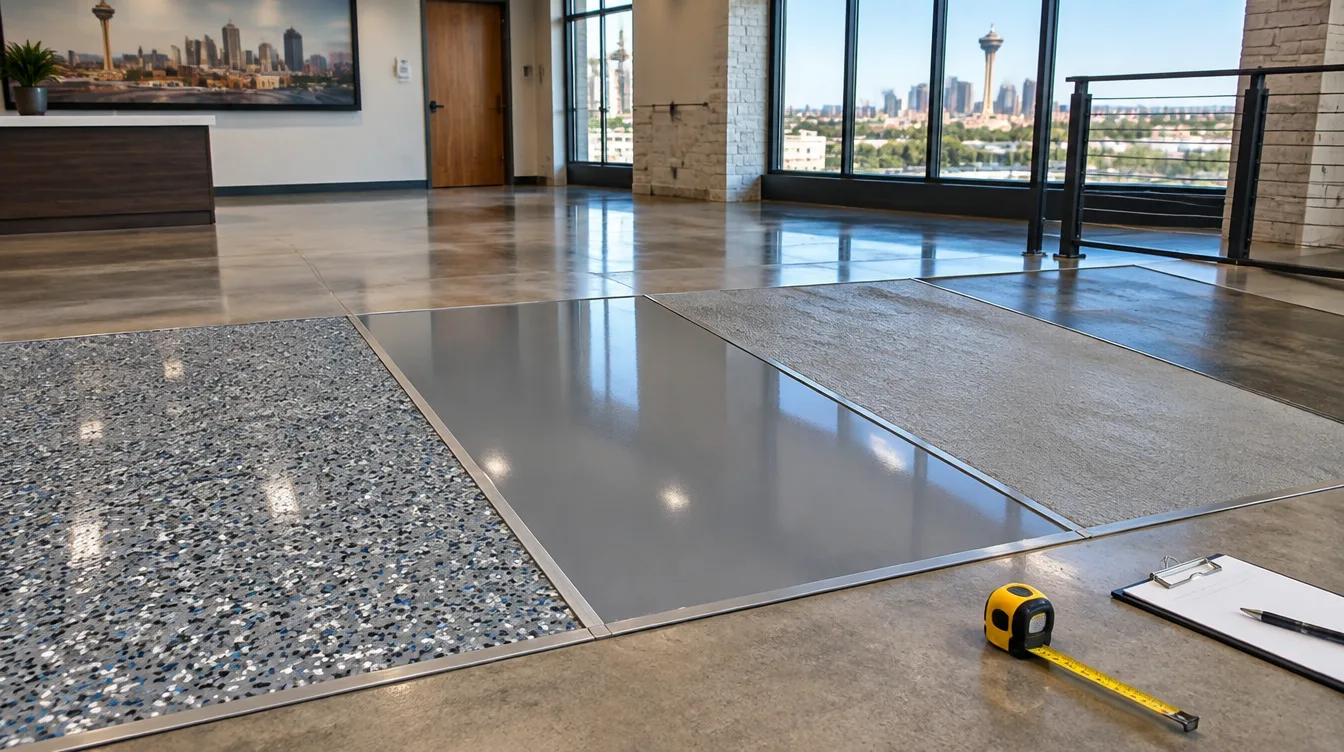
Commercial epoxy flooring in San Antonio is priced per square foot by system, and the installed bands run from about $3 to $5 for a thin roll-applied coating, $5 to $8 for broadcast flake or quartz, $7 to $10 for troweled mortar, and $8 to $15 for urethane cement. The system you specify sets the band, and prep condition, mobilization and shift work move your quote within it. This page is a unit-rate reference. For the full project picture, including the whole-job cost breakdown, see our commercial epoxy flooring page and the commercial cost guide linked below.
Quick answer: installed rate bands by system, in one table
Installed commercial epoxy rates in San Antonio fall into four system bands, and the table below shows each one with what it is typically used for. These are planning ranges consistent with the rates we publish across this site, and a measured on-site quote replaces them.
| System | Typical installed rate | Where it is used | What drives the rate |
| Thin-mil roll-applied epoxy | $3 to $5 per sq ft | Retail, offices, light commercial | Prep and coat count |
| Broadcast flake or quartz | $5 to $8 per sq ft | Warehouses, showrooms, healthcare | Material volume and topcoat |
| Troweled epoxy mortar | $7 to $10 per sq ft | Kitchens, heavy-wear and repair areas | Thickness and hand labor |
| Urethane cement | $8 to $15 per sq ft | Food plants, wet and thermal-shock areas | Material, thickness and specialist install |
Two points keep the table honest. The bands overlap, because a heavy flake system and a light mortar system can price alike. And a rate quoted per square foot is only comparable to another if both quotes cover the same system, the same thickness and the same preparation, which the last section covers.
Thin-mil roll-applied epoxy: where it belongs and what it costs
A thin-mil roll-applied epoxy typically installs at $3 to $5 per square foot and belongs on lightly trafficked floors where appearance and dust control matter more than impact resistance. Think of retail floors, offices, back-of-house corridors and storage rooms that see foot traffic and the occasional cart.
The system is usually a primer and one or two coats rolled on over a ground slab, often with a clear topcoat for wear. Film thickness is low, commonly in the single-digit to low double-digit dry mils, which is why it prices at the bottom of the range. It seals the slab against dusting and stains and gives an easy-to-clean surface, but it does not take forklift loads, dropped tools or aggressive chemicals the way a thicker system does.
The false economy is putting a thin coating where the floor needs a heavier one. A thin system on a loading dock or an active warehouse aisle wears through at the traffic lanes, and re-coating later costs more than specifying the right thickness at the start. For how thickness maps to application, our guide to industrial epoxy floor thickness lays out the dry-mil ranges by use.
Surface preparation sets the floor under the rate. Grinding the slab to a defined profile, with ICRI 310.2R describing the CSP 1 to 9 scale, is what lets even a thin coating bond, and a pull-off test under ASTM D4541 is how adhesion is verified when a specification calls for it.
Broadcast quartz and flake systems: material volume drives the rate
Broadcast flake and quartz systems typically install at $5 to $8 per square foot, and the extra cost over a thin coating is almost entirely material and labor steps. A base coat is rolled or squeegeed, aggregate or flake is broadcast into it to refusal, and one or more topcoats lock it in.
The broadcast does three jobs. It adds film thickness, it gives the surface texture for slip resistance, and it hides imperfections in the slab and wear from traffic. That makes the system a common choice for warehouses and distribution floors at the lower end of the band, and for showrooms and healthcare corridors at the upper end, where a decorative blend and a polyaspartic or urethane topcoat are specified.
Within the band, three things move the rate: how heavily the aggregate is broadcast, how many topcoats are applied, and whether the topcoat is a standard epoxy or a UV-stable, chemical-resistant product. A full broadcast with two topcoats costs materially more than a light scatter with one, even though both are called flake systems.
If slip resistance is a requirement, ask for the dynamic coefficient of friction under ANSI A326.3 rather than relying on the word textured. Wet areas and ramps are where an aggregate-rich finish earns its price.
Troweled mortar systems: the high end and what justifies it
Troweled epoxy mortar typically installs at $7 to $10 per square foot, the top of the epoxy range, because it is applied by hand at much greater thickness than a rolled or broadcast system. The mortar is a mix of resin and graded aggregate troweled to a smooth, dense surface, often a quarter inch or more thick.
That thickness is what justifies the price. A mortar system carries heavy point loads, resists impact and abrasion, and can level out damaged areas, patched joints and uneven slabs in the same pass. It is the system specified for kitchens with heavy equipment, repair zones and floors where a thinner coating has already failed. It also takes longer to apply, because troweling is skilled hand labor that does not speed up with crew size the way rolling does.
The cost of a mortar floor tracks its thickness. Doubling the build roughly doubles the material volume and often adds a cure day, so the first question when comparing two mortar quotes is the thickness, not the rate. Mortar overlaps urethane cement at the high end of the price range, and the choice between them comes down to moisture and thermal exposure rather than price alone.
Urethane cement: why it prices above epoxy and when it is still cheaper
Urethane cement typically installs at $8 to $15 per square foot, above epoxy, because the material costs more, goes down thicker and needs specialist application. It is a cement-based polyurethane hybrid specified where thermal shock, constant moisture or aggressive chemicals would destroy an epoxy, which is why it dominates food processing, commercial kitchens and wash-down areas.
Published rates for this system vary with the application, from $8 to $14 for food manufacturing in our commercial cost guide to $8 to $15 on our urethane cement page. The spread reflects thickness and site conditions, so treat the band as a range and not a single price. Our urethane cement vs epoxy cost comparison works through the lifetime-cost argument in full, and our urethane cement floor page covers the system itself.
The upfront premium is real, but it is not always the higher cost over the life of the floor. In a room that thermal-shocks an epoxy, such as a kitchen with steam and cold wash-downs, an epoxy that fails and is re-coated every few years can cost more over time than a urethane cement installed once. In a dry, ambient warehouse, there is no such case, and epoxy remains the cheaper floor. The point is to match the system to the exposure, not to default to the cheapest or the most expensive.
What moves a quote within a band: prep condition, mobilization, shift work
Within any system band, the quote moves with the condition of the slab, the size and logistics of the job, and when the work can happen. These are the same cost factors covered in detail in our commercial epoxy flooring cost guide, so this section stays on how they shift a unit rate.
Prep condition. A clean, sound slab needs grinding and cleaning. A slab with an old coating, VCT tile and mastic or heavy contamination needs removal first, which adds roughly $1 to $3 per square foot in our commercial pricing. Moisture is the other prep variable. A slab that fails an ASTM F1869 calcium chloride test or an ASTM F2170 in-situ humidity test needs a moisture mitigation primer, and that adds material and a cure step.
Size and mobilization. Fixed costs such as setup, containment and crew travel are spread over the area, so large floors price lower per square foot. On commercial jobs of 10,000 square feet and up, the unit rate typically drops by 15 to 25 percent, while a small room prices above its band.
Shift work. Businesses that cannot close need overnight or weekend installs, which adds roughly 15 to 25 percent to labor. A floor that can be cleared for two to three days costs less than the same floor done between shifts.
Details that are priced separately. Coved base, drain slope work and joint treatment are often quoted per linear foot or per affected area rather than rolled into the unit rate, so a floor with a lot of perimeter can cost noticeably more than its square-foot rate suggests.
Matching a rate band to your floor before you request bids
The fastest way to a usable budget is to choose the system first and the rate second. Start with what the floor has to survive: foot traffic and carts point to a thin-mil or light flake system, forklifts and abrasive grit point to a broadcast or mortar build, and steam, cold wash-downs or constant moisture point to urethane cement. Then read the matching row in the table above.
Next, adjust for scale. As a worked example using the published rate behavior, a small floor quoted at $6 per square foot might price nearer $4.50 to $5.10 per square foot on a 10,000 square foot job of the same system, since large jobs typically run 15 to 25 percent lower per square foot. That arithmetic shows why a rate pulled from a small-room quote should never be multiplied across a warehouse.
Finally, add the separately priced items for your site, such as removal, coved base or after-hours work, and request bids that name the same system and itemize preparation. A budget built this way is usually close enough to decide whether a project is viable before anyone visits the site.
Reading a unit rate correctly: what is and is not included per square foot
A per-square-foot rate is only meaningful if you know what it includes, and the most common reason two commercial quotes cannot be compared is that one includes preparation and the other does not. Ask every bidder the same four questions.
First, is surface preparation included, and by what method? Diamond grinding to a stated profile, patching of cracks and spalls, and any moisture mitigation should be itemized, not buried. A rate that excludes them looks lower and is not.
Second, what is the system, in writing? Product name, number of coats and the thickness in dry mils for each, since a quote that says "16 mils" without saying wet or dry may not be comparing like with like. Our guide to industrial thickness explains the wet versus dry difference.
Third, what is excluded? Coved base, drain work, joint filling, removal of an existing coating and after-hours premiums are the usual extras, and each can add a meaningful amount on a given floor.
Fourth, how is area measured? The quote should state the measured square footage so the total divided by the area reproduces the rate. When the area is written down, you can check the math and compare bids on the same footing.
Done this way, a $4 quote and a $6 quote become comparable. Often the difference is a thicker system or an included prep step, not a better or worse contractor.
Frequently asked questions
What does commercial epoxy flooring cost per square foot installed?
Installed rates span a wide band because the term covers several different systems. A thin roll-applied coating sits at the low end, broadcast flake and quartz in the middle, and troweled mortar or urethane cement at the top.
Why do commercial epoxy quotes vary so much per square foot?
Because the system is rarely specified the same way twice. Mil build, number of coats, prep method and whether work happens on a night shift can each move the rate more than the floor area does.
Is urethane cement more expensive than epoxy?
Per square foot, generally yes. It is specified where thermal shock, moisture or aggressive chemicals would destroy an epoxy, and in those conditions the longer service life often makes it the cheaper floor over time.
Does a unit rate include surface preparation?
Not always, and this is where quotes stop being comparable. A rate that excludes grinding, patching or moisture mitigation will look lower than one that includes them, so prep should be itemized separately.
How much does mil thickness affect cost?
Materially. Doubling the mil build roughly doubles the material volume and often adds a coat and a cure day, so thickness is one of the first things to confirm when comparing two rates.
If you are budgeting a commercial floor, call (830) 355-3303 for a free on-site measure and written quote, or review our commercial epoxy flooring page to compare systems before you request bids.